Sigrid for banking and financial services | Software Improvement Group

Sigrid® for banking and financial services

AI coding agents write code fast. Sigrid checks that it is secure, maintainable, and fits your architecture.

Trusted by banks and financial institutions including

  • ABN AMRO
  • ING
  • Eurobank
  • Allianz
  • S&P Global

Named a Leader in the 2026 Gartner® Magic Quadrant™ for Technical Debt Management Tools. Get the analyst report

  • 40,000+Benchmarked systems
  • 600B+Lines of code
  • ISO/IEC 17025Accredited software quality lab
  • ISO/IEC 25010Quality model
  • ISO/IEC 27001Certified
  • SOC 2Compliant
  • ISO Guide 65Compliant
  • CISQ & NENStandards contributor

The current state of software in banking and financial services

Software Improvement Group's benchmark of more than 40,000 systems shows that much of the code in banking and financial services falls below recommended quality standards before an agent ever touches it, and AI-generated code adds risk of its own.

Share that falls short of the recommended rating

Maintainability78%

78% of financial services code falls below the recommended maintainability rating, against 86% globally. Every mandated reporting change lands on systems that already carry years of accumulated change, and maintainability decides whether it ships in weeks or slips.

Financial Services Outlook 2027, Chapter 3. Share of code volume.

Architecture52%

52% of financial services code falls below the recommended architecture quality rating, against 50% globally. By system, 40% fall below it, so the weakest architecture sits in a smaller number of large systems.

Financial Services Outlook 2027, Chapter 5. Share of code volume.

Security controls72%

72% of financial services code has a low degree of security controls, against 71% globally. Large systems score lowest and tend to process the most sensitive data.

Financial Services Outlook 2027, Chapter 4. Share of code volume.

Open source health47%

47% of financial services systems score below the recommended open source health rating. The average enterprise organization relies on 132 open source libraries, and open source dependencies are the most likely vector for an AI-assisted attack.

Financial Services Outlook 2027, Chapter 4. Share of systems, not code volume. The recommended rating is 3.5 stars.

Global figure

78%

of financial services code falls below the recommended maintainability rating

86% globally

AI-generated code

1.4%of enterprise production code in financial services is AI-generated

Detection covers Java, C#, and Python, so the true share is likely higher. Developers report far higher shares of newly merged code, but those figures are self-reported.

Financial Services Outlook 2027, Chapter 1. Share of enterprise code in production.

2xthe security risk violations in AI-generated code compared with human-written code

The experiment compared 16 projects built by four popular LLMs with human-written projects. The set was limited, so test the result against your own code.

Financial Services Outlook 2027, Chapter 1.

72%of AI systems score below the recommended maintainability rating

About 70% of organizations with an AI system run traditional AI and machine learning, such as fraud flags, and about 15% run agentic systems. Their maintainability bears on how fast they can be updated.

Financial Services Outlook 2027, Chapter 6. Benchmark-wide figure. The recommended level is 3.5 stars.

What it costs

€870,000per system per year in developer time freed by moving from 2 to 4 stars of maintainability

That is 5.8 full-time developers. A large enterprise running 10 systems at 2 stars carries roughly €9 million per year in unnecessary maintenance overhead.

Financial Services Outlook 2027, Chapter 2. Calculated at an average developer cost of €150,000 per year.

€120,000per year in token spend for a team of 50 developers using non-agentic AI coding

That equals nearly one additional full-time developer. Agentic coding tasks can use up to 1,000 times more tokens than standard code chat.

Financial Services Outlook 2027, Chapter 1. SIG calculation at €200 per developer per month, based on a published Anthropic estimate.

Security exposure

7.5%of financial services systems are large, the smallest share of any industry in the benchmark cut

Large systems have the weakest security posture in the portfolio. If those systems include core ledgers, payment rails, or clearing systems, a breach does not stay contained to one department.

Financial Services Outlook 2027, Chapter 4. Share of systems.

20critical security findings in the average-sized system

Broken access control (31.5%) and injection (23.4%) are the most detected OWASP Top 10 findings.

Financial Services Outlook 2027, Chapter 4. Benchmark-wide figure.

+72%higher security rating for systems with 4-star maintainability than for 2-star systems

Well-structured, low-debt code is auditable, testable, and patchable. A high security rating does not guarantee full security.

Financial Services Outlook 2027, Chapter 2. A correlation across the Sigrid benchmark.

What Sigrid does for banking and financial services

Sigrid measures the software you have and checks the code AI writes next.

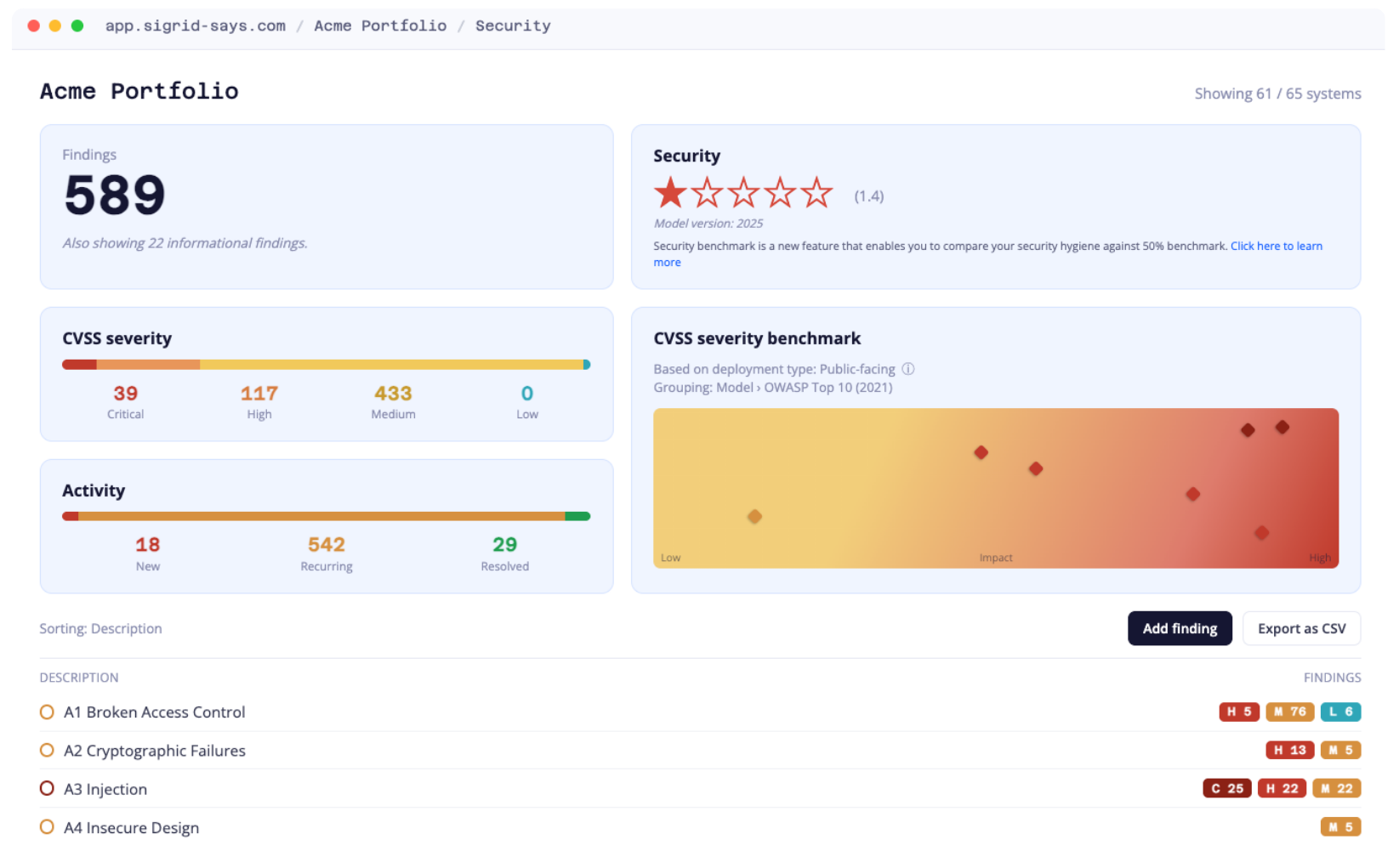
Sigrid Core security overview

Sigrid Core

See where your software stands

Rates maintainability, architecture, security, and open source health for every system against one benchmark, so you know which to fix first.

4.5×faster time to market after reducing technical debt
−50%lower software maintenance cost
+30%more development capacity freed up
2×fewer security vulnerabilities in production
Explore Sigrid Core
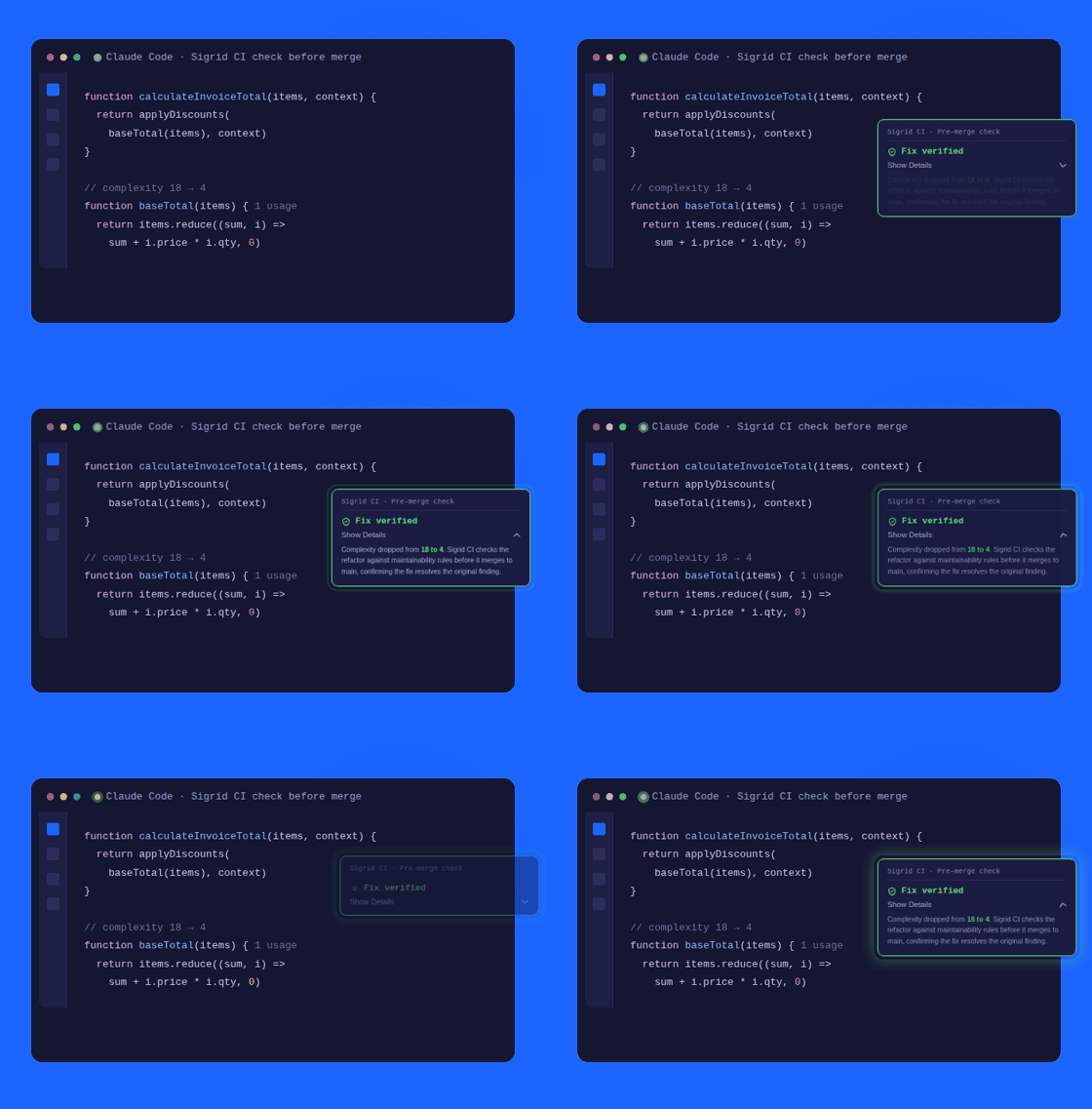
Animated demo of Sigrid Axis working inside an AI coding agent

Sigrid Axis

Check what AI writes before it is committed

Plugs into Claude Code, GitHub Copilot, Cursor, and ChatGPT through MCP and checks every change against your architecture and standards.

30%faster delivery
97%fewer high-risk security findings
40%reduction in token consumption
85%fewer issues flagged in pull requests
Explore Sigrid Axis

Built for the agentic development lifecycle

Axis anchors agents in your architecture, plans their work, catches risk in real time, and cleans up what's already there. Hover a step to see it on the loop.

1

Ground

Gives your AI agents a continuous, accurate map of your architecture, so they act with full context and burn fewer tokens.

Understand current architecture, explore the code base.

2

Plan

Surfaces current and emerging risks, writes the plan to fix them, and recommends the right model for the job.

Triage security findings, prepare OSS upgrades, prepare rearchitect scenarios.

3

Prevent

Checks every agent change against your architecture, security, and quality standards. Drift and new vulnerabilities get flagged before they land, and token spend goes down instead of up.

Guardrail security issues, guardrail maintainability issues, prevent architecture drift.

4

Improve

Refactors technical debt and security risks on its own, then hands a cleaner map back to Ground. Your team ships instead of cleaning up.

Maintainability refactoring, OSS patching, security remediation, architecture correction.

What customers say

“When we pushed for it and embarked on the journey, SIG’s tooling picked up those kinds of languages quickly… It helped us keep control of technical debt and identify where we needed to focus.”

Harald ThoonenSolution Architect, Rabobank

“Modern banks have become high-end IT companies. Today the “black box” character of many systems is still dominant, which often causes unexpected and costly problems and also quickly translates into reputation damage. Based on my experience, I can confirm that certification adds great value by making software quality transparent and it creates a neutral understanding and objective basis for improvement.”

Sander VeenstraPrincipal IT Application Development Expert, European Central Bank

“SIG’s analysis of the Jenius rebuild scenario shows that improved code quality will reduce our maintenance cost by an estimated 78% and decrease the time needed to make changes by a factor of 3.”

Karim SiregarCIO, Bank BTPN

Questions banking and financial services leaders ask

Is financial services code ready for AI coding agents?

Partly. According to Luc Brandts, CEO of Software Improvement Group (SIG), financial services has the strongest maintainability figures of any industry SIG benchmarks. Yet 78% of its code still falls below the recommended maintainability rating, 52% falls below the recommended architecture rating, and 72% has a low degree of security controls. AI amplifies what is already there, so the quality of that code shapes how safely institutions can scale AI coding agents.

How good is the software quality of financial services systems?

78% of financial services code falls below the recommended maintainability rating, 52% falls below the recommended architecture rating, and 72% has a low degree of security controls. All three are shares of code volume. Of the systems analyzed, 47% score below the recommended open source health rating. The figures come from Sigrid analysis of financial services systems from the past year.

How much code in financial services is written by AI?

Sigrid measures 1.4% of enterprise code in production in financial services as AI-generated. That is a share of an entire body of code, most of it written years or decades before these tools existed. Detection covers Java, C#, and Python with over 95% accuracy, so the true share is likely higher. Developers report far higher shares of new code: DX's Q2 2026 report found 52.7% of merged code is AI-authored, but that figure is self-reported.

Is AI-generated code riskier than human-written code?

In SIG's analysis, yes. In a SIG experiment with 16 projects built by four LLMs, AI-generated code carried roughly double the security risk violations of human-written code. SIG's Java data also shows AI-generated code is less maintainable, and the gap widens as systems grow. The experiment was limited in size, so it is a signal to test against your own code.

Do AI coding agents use fewer tokens in well-structured code?

Early evidence says yes. In an experiment published on Martin Fowler's site, Giles Edwards-Alexander, CTO for Europe, Middle East and India at Thoughtworks, had AI agents build a 150,000-line app, then refactored its largest file step by step. Input tokens for the same change fell 83%, from about 160,000 to about 27,000. The code did not shrink. The agent had less to read. It is a single experiment on one application, with approximated token counts, so it is a signal to test against your own code.

How do you govern AI coding agents in a financial institution?

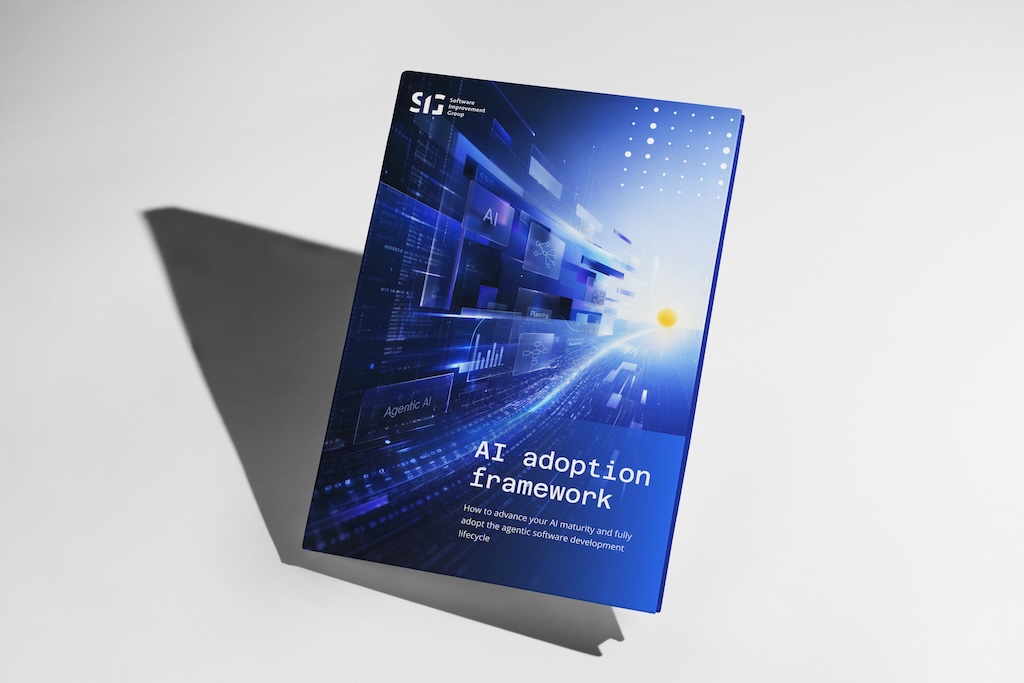
Build a harness around the agents: guide files that describe your architecture and standards, context for each task, automated checks on every change, and risk-based human review. Sigrid Axis runs those checks inside the agent's loop through MCP, with Claude Code, GitHub Copilot, Cursor, and ChatGPT, and fixes what it finds before the code is committed. The checks are deterministic, so the same code gets the same result every time, and every decision, whether fixed, accepted, or flagged as a false positive, is written back to Sigrid as a status update, which gives you a full audit trail. SIG's AI Adoption Framework describes the governance each stage of adoption needs.

What did SIG's Guardrails experiment show?

SIG built the same project management system 20 times with Claude Sonnet 4.6, changing one variable: whether Sigrid Guardrails ran a mandatory quality and security check inside the agent's build loop. With the check in place, high-risk security findings fell by roughly 97% and the maintainability score rose by roughly 24%. Every guided build scored higher on maintainability than every unguided build. It is a single experiment on one task and one model, not a universal law. Read the full write-up.

What is the difference between Sigrid Core and Sigrid Axis?

Sigrid Core continuously measures maintainability, security, architecture quality, and open source health across an entire software portfolio, and sets the standards. Sigrid Axis applies the same analysis inside the agentic software development lifecycle, holding AI coding agents to those standards as they write code. Both run on the same benchmark and models.

Ensure AI coding agents create business impact

Request a free trial of Sigrid Axis or Sigrid Core, or read the full Financial Services Outlook 2027 for the benchmark behind them.

Gartner and Magic Quadrant are trademarks of Gartner, Inc. and/or its affiliates. Gartner does not endorse any company, vendor, product or service depicted in its publications, and does not advise technology users to select only those vendors with the highest ratings or other designation. Gartner publications consist of the opinions of Gartner's business and technology insights organization and should not be construed as statements of fact. Gartner disclaims all warranties, expressed or implied, with respect to this publication, including any warranties of merchantability or fitness for a particular purpose.

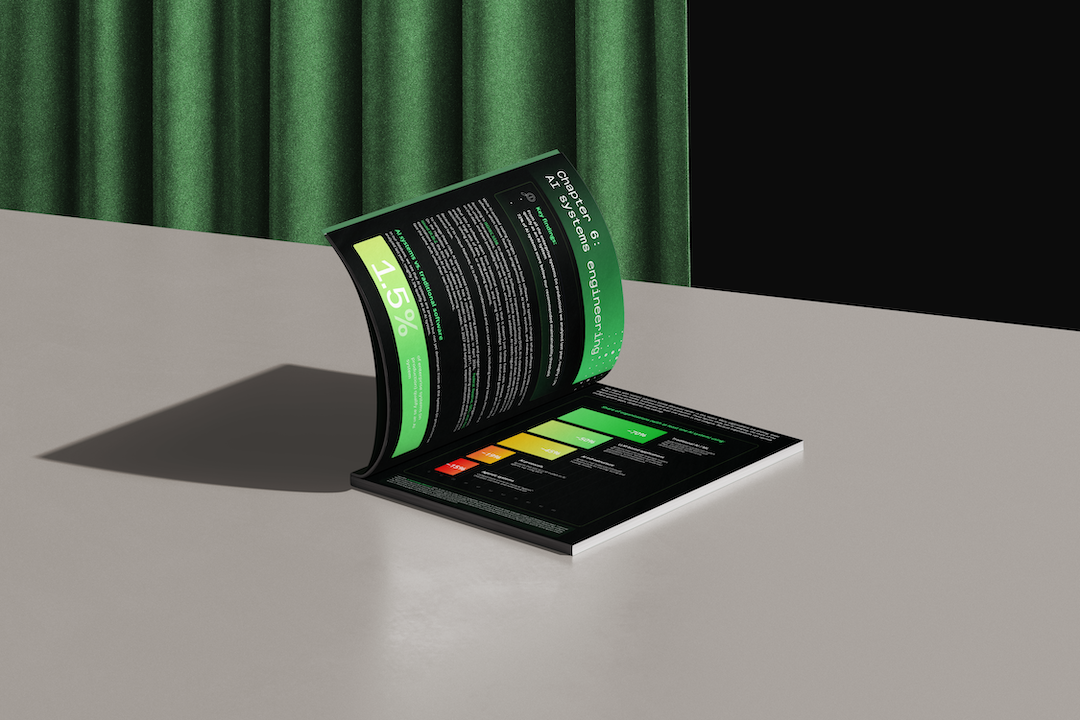
Download the full report

This field is for validation purposes and should be left unchanged.
Name*
Privacy*

Read our methodology

This field is for validation purposes and should be left unchanged.
Name*
Privacy*

Watch Core in action

This field is for validation purposes and should be left unchanged.
Name*
Privacy*

Watch Axis in action

This field is for validation purposes and should be left unchanged.
Name*
Privacy*

This field is for validation purposes and should be left unchanged.
Name*
Privacy*

This field is for validation purposes and should be left unchanged.
Name*
What type of partnership are you interested in?*
Privacy*

Register for access to Summer Sessions

This field is for validation purposes and should be left unchanged.
Name*
Privacy*