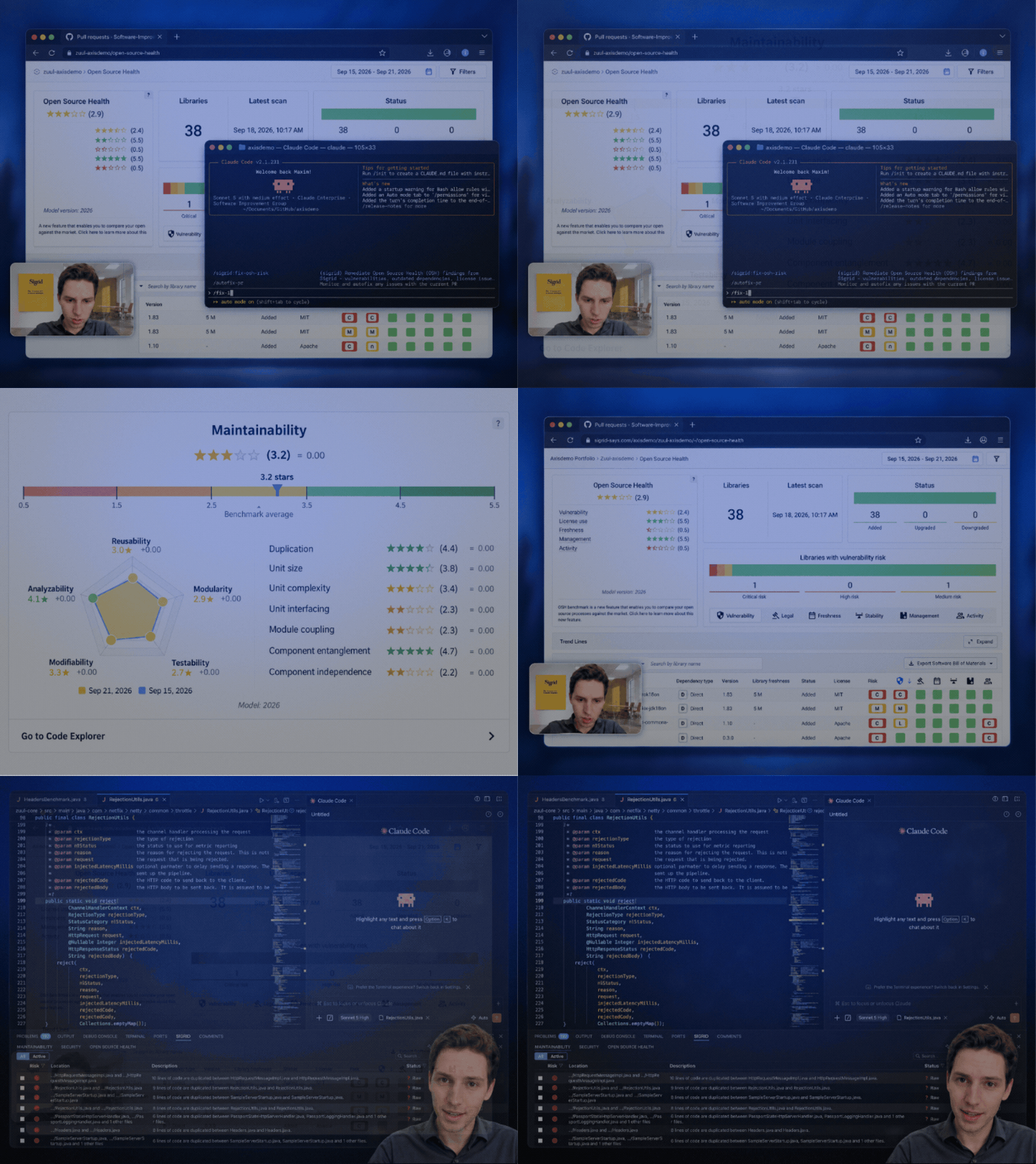
Catch quality and security issues the moment your AI writes them, not after they ship.
The Sigrid Security Guardrails analysis has detected a formatted string in a SQL statement that I need to address:
The vulnerability: The getTransactionHistory() method concatenates user input directly into the SQL query. An attacker could pass '; OR '1'='1' to retrieve all transactions, or worse, '; DROP TABLE transactions; -- to delete data.
Secure version using PreparedStatement.java








Fewer high-risk security findings with Sigrid Guardrails
SIG guardrails experiment, 2026 (read the study)Higher maintainability score with Sigrid Guardrails
SIG guardrails experiment, 2026 (read the study)See Sigrid Guardrails catch an issue in real time, before it's committed.
Requesta free trialMost AI code quality tools scan after the fact. Sigrid Guardrails checks maintainability and security together, in real time, backed by the world's largest benchmark dataset of real-world systems.
Checked against 30,000+ real-world benchmarked systems, so issues get caught before they reach review, not after.
Runs in real time, without needing to publish your system to Sigrid first, while the agent still has full context on what it just wrote.
Manual review already struggled to keep up with human developers. AI generates code faster still. Guardrails runs the check automatically, so speed doesn't turn into a backlog of debt.
Sigrid Guardrails returns findings on maintainability and security within seconds, so teams can act fast and stay in control.
The Sigrid Code Quality Guardrails analysis has identified some maintainability issues that I need to address:
Code Duplication (VERY_HIGH severity): There's duplicated code in the BankAccount class between the depositCash() and depositCheck() methods.
I also notice a critical security vulnerability in the existing getTransactionHistory() method. It uses string concatenation for SQL queries, making it vulnerable to SQL injection attacks.
Let me fix these issues by refactoring the code.
Auto-Fix Agents work from Sigrid's continuous, accurate map of your architecture, so every fix is grounded in how your system actually looks today, not a stale guess.
Sigrid identifies and prioritizes the risks worth fixing first, and hands each one to the right agent for the job.
Auto-Fix Agents refactor technical debt and security risks, then hand a cleaner map back to Ground.
Sigrid Guardrails checks every agent change in real time, stopping new risk and drift before they enter your codebase.
You're already using Guardrails to keep new code clean as it's written. Work with Auto-Fix Agents when you're ready to tackle the technical debt that already exists. Either way, the AI coding tools your team already uses tap into Sigrid's analysis as they work.
Checked against 40,000+ real-world benchmarked systems. Flagged directly in the IDE before the task closes.
Flagged as the agent writes, before issues move into a commit or downstream into a pipeline.
AI tools move logic across files without knowing which parts belong together. The Architecture guardrail gives them that missing context.
LLMs, AI coding assistants, and AI agents can generate code and even review it, but they share the same limitation. They reason through associative, pattern-based matching, which makes them fast but not reliably accurate, and they can miss flaws they don't have full context on.
That's why AI-generated code needs deterministic analysis tools and expert review, on top of whatever the model already checks itself.
Most harness-level guardrails are prompts telling the model to write good code, or basic linting rules. Sigrid Guardrails checks against a deterministic analysis engine benchmarked against 40,000+ real-world systems, so the check doesn't depend on the model interpreting an instruction correctly.
It plugs into the harness you already have, instead of replacing it.
You can build a custom linter or a set of house rules, and many teams do. What's hard to build in-house is the comparison point: knowing whether your maintainability score is actually good relative to 40,000+ real-world systems, or just internally consistent.
That benchmark took SIG 25 years and the world's first and only ISO/IEC 17025-accredited software quality lab to build. Sigrid Guardrails gives your AI agents access to it directly, instead of asking your team to recreate it.
MCP stands for Model Context Protocol, an open standard that lets AI models connect to external data sources and tools. Think of it as a USB-C port for AI.
Sigrid Guardrails lets AI coding assistants, agents, and other MCP-based tools call on Sigrid's code analysis directly, using MCP as the connection protocol. It checks both new and existing code for security vulnerabilities and quality issues as it's generated, so agents can catch and fix problems in real time instead of downstream in a build pipeline.
An MCP server extends what a language model can do by letting it call external code to complete tasks it can't handle alone. Ask a frontier model to review code for security issues, and it compares the snippet against patterns from training, then returns a stochastic assessment. That works well most of the time, but it's still a guess.
An MCP server lets the model send the code to a deterministic tool like Sigrid and get back the actual, verified findings, not a pattern match.
Sigrid Guardrails integrates with AI coding assistants and agents, not IDEs directly. Some IDEs are themselves AI coding assistants, like Devin Desktop and Cursor. Others support AI coding assistants through plugins, like VS Code with GitHub Copilot.
JetBrains IDEs (IntelliJ, PyCharm, WebStorm) aren't natively supported yet. Getting MCP running currently requires a manual configuration workaround, and there's an open tracking issue for native support. Junie, JetBrains' own coding assistant, doesn't support the MCP protocol at all.
Most modern IDEs support some AI coding assistant today, and most AI coding assistants support MCP.
Java, Python, C/C++, C#, JavaScript, TypeScript, Kotlin, Progress ABL, and PHP.
See the Technology Support page for details.
Yes, in three ways. Call it directly ("Run Sigrid on these files...") for on-demand checks. Set it as a gate before commits, so issues are caught before they enter your repository. Or make it a mandatory gate after every task, so nothing is handed back until it passes.
You choose how deeply it integrates into your workflow.
In agentic workflows, the model generates code, uses tools, accesses systems, and completes multi-step tasks on its own. MCP gives it a standard way to connect to those tools and sources of context, which makes it easier to add checks, controls, and trusted data into the workflow.
A coding agent plans and carries out tasks. MCP is the protocol that lets that agent connect to external tools, data, and workflows. MCP is part of the infrastructure that makes agentic coding useful, and governable.
Coding agents can generate and update code quickly, but speed doesn't guarantee maintainability, security, or architectural quality. Objective checks let teams assess AI-generated code against clear standards, instead of relying on the model's own confidence.