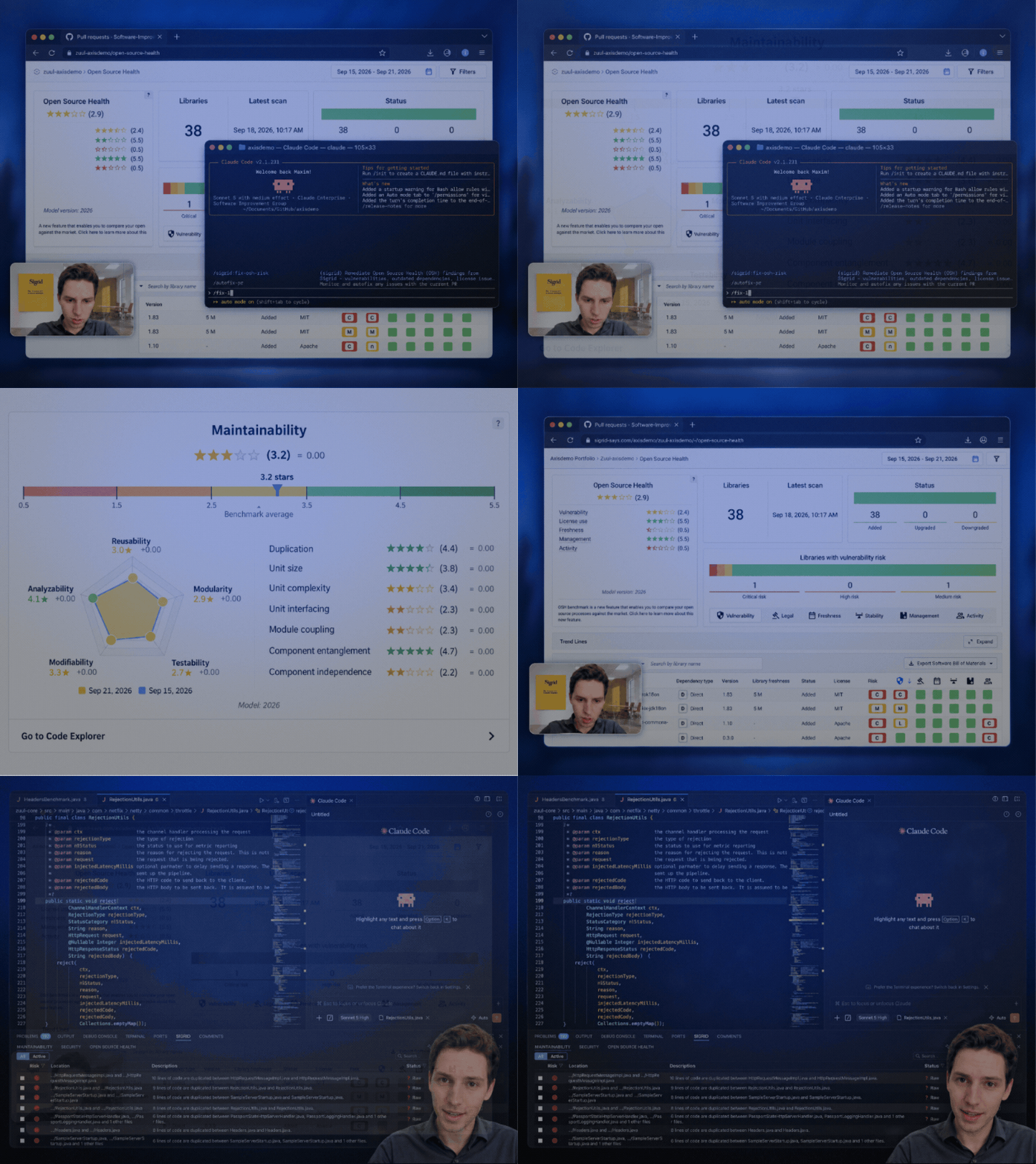
Auto-Fix Agents give your AI coding agent a prioritized list of findings from Sigrid — maintainability, security, reliability, and open source health. It works through the list, fixes what it can, and marks each finding resolved.
Complexity dropped from 18 to 4. The refactor is re-analyzed against Sigrid's maintainability rules and confirmed to resolve the original finding.
Proposed by Claude Code, verified by Sigrid — ready for review.








Faster time to market
SIG customer outcomes, 2026 — pairing AI adoption with governed remediationLower maintenance cost
SIG customer outcomes, 2026 — pairing AI adoption with governed remediationFewer security findings introduced
Sigrid Guardrail experiment on Claude Sonnet 4.6, 2026 — read the study. Measures Guardrail's real-time checks, not Auto-Fix Agents directly.See Auto-Fix Agents fix a real finding from your own portfolio.
Watch a demoSecurity, architecture, maintainability, open-source, and reliability findings, all served through Sigrid's MCP tools.
Connect the Sigrid MCP server to Claude Code, GitHub Copilot, or ChatGPT — whichever your team already uses.
Ask for discovery-only, triage-then-fix, or a fully autonomous pass.
Every finding traces back to Sigrid's fact-based rules and architectur context.
Ranks refactoring candidates — duplication, unit size, complexity, module coupling — against your portfolio's own standards, and fixes what it can.
Fetches findings by severity, investigates real-world exploitability in context, fixes what it can, and marks false positives with justification.
Queries dependency risks — vulnerabilities, outdated libraries, license issues — and reports priorities and upgrade paths. Informational: there's nothing to auto-fix here, by design.
Works through error handling, concurrency issues, and resource management — fixing the straightforward cases and flagging the complex ones for review.
Guards against drift as code moves across files and modules faster than teams can review it.
See these agents work against your own codebase.
Request a free trialEvery prompt runs in the mode that matches how much trust you're ready to extend — from fully hands-off to fully reviewed. Mix modes across finding domains, or even within one session.
Surfaces and ranks findings with no code changes, so you decide what's worth fixing.
The agent triages findings first — will-fix or accepted — then picks up the will-fix items on your go-ahead. Nothing ships without sign-off.
Give it a target property and your decision criteria, and it works through findings in a loop — fixing what it can and updating status as it goes.
Pick the mode that fits — we'll show you each one live.
Request a free trialAuto-Fix Agents work from Sigrid's continuous, accurate map of your architecture, so every fix is grounded in how your system actually looks today, not a stale guess.
Sigrid identifies and prioritizes the risks worth fixing first, and hands each one to the right agent for the job.
Auto-Fix Agents refactor technical debt and security risks, then hand a cleaner map back to Ground.
Sigrid Guardrails checks every agent change in real time, stopping new risk and drift before they enter your codebase.
You're already using Auto-Fix Agents to tackle the technical debt that already exists. Work with Sigrid Guardrails when you're ready to keep new code clean as it's written. Either way, the AI coding tools your team already uses tap into Sigrid's analysis as they work.
See Auto-Fix Agents run against a real finding from your own portfolio.
Request a free trialA generic AI coding assistant has no view of your codebase's standards or history — it's making its best guess. Auto-Fix Agents work from findings Sigrid has already triaged against your portfolio's own standards, and every proposed fix is re-analyzed by Sigrid to confirm it actually resolves the issue before anyone reviews it.
No. You choose the mode in your prompt: discovery-only surfaces findings with no code changes, triage-then-fix requires a developer's sign-off before anything ships, and autonomous fixing works through findings in a loop and updates their status as it goes. You can set the mode per prompt, per finding domain.
Auto-Fix Agents connect to Claude Code, GitHub Copilot, and ChatGPT today. No new agent to learn — the fix is handed to the coding tool your team already uses.
In discovery or triage mode, a developer reviews the proposed fix before anything ships. In autonomous mode, Sigrid re-analyzes the fix to confirm it actually resolves the finding before it's handed back. Every decision is written back to Sigrid as a status update, so there's a full audit trail of what changed and why.
Four finding domains today: Maintainability (duplication, unit size, complexity, coupling), Security (findings by severity), Reliability (error handling, concurrency, resource management), and Open-Source Health (vulnerabilities, outdated libraries, license risk — reported, not auto-fixed). An Architecture domain, guarding against structural drift, is on the roadmap.
Auto-Fix Agents work from findings Sigrid has already triaged, so they run on top of your existing Sigrid analysis. They pair well with Sigrid Guardrail, which checks agent-written code against your standards in real time as it's written — Auto-Fix Agents handle what's already in the codebase, Guardrail handles what's being added to it.
Auto-Fix Agents are in early access. The current tools cover the core refactoring, security, reliability, and open-source health workflows described above, and we're actively adding more.
Java, Python, C/C++, C#, JavaScript, TypeScript, Kotlin, Progress ABL, and PHP.
See the Technology Support page for details.