Software Improvement Group has been named a Leader in the 2026 Gartner® Magic Quadrant™ for Technical Debt Management Tools.
Sigrid® Axis
Control built into the agent's loop: powered by the largest software quality benchmark, highest standards and your full architectural context.
40,000+
Benchmarked systems
ISO 25010 · 17025 · 27001 · SOC2
Rooted in international standards
600B+
Lines of code
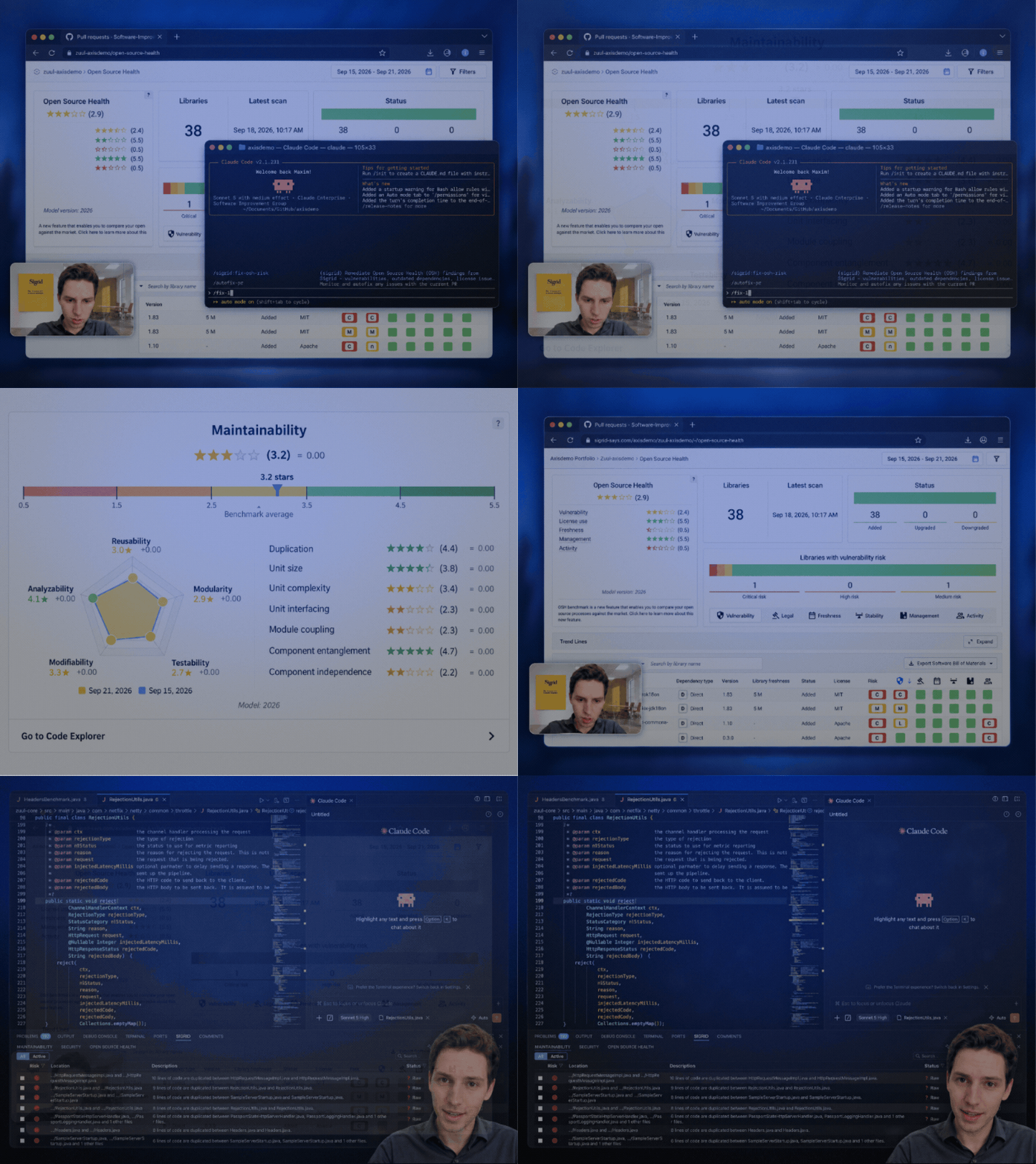
Complexity dropped from 18 to 4. The refactor is re-analyzed against Sigrid's maintainability rules and confirmed to resolve the original finding.
Proposed by Claude Code, verified by Sigrid — ready for review.
Axis plugs into the AI coding tools your team already uses. No new agent to adopt, no workflows to relearn.






Axis connects through MCP, the open standard your tools already speak.
Why now
Organizations are moving from AI-assisted coding to autonomous agents that write while humans review by outcome. Prompting more carefully or asking another AI to check the output inherits the same weaknesses. What's missing is a standard that gives the same answer every time, applied the moment code is written.
63%
Of organizations report no enterprise-level EBIT impact from AI
McKinsey, The State of AI, Q3 2026 (read the report)
53%
Of large U.S. enterprises are already deploying AI agents
KPMG AI Pulse Survey, Q2 2026 (read the survey)
50%
Increase in defects some teams see in AI-generated code
DX, AI-Assisted Engineering, Q1 2026 (read the article)
How Axis helps
Get clarity on the four dimensions shaping your agentic software development lifecycle.
See which teams have gone AI-native, what they're doing right, and why others are lagging.
Control spend and maximize the ROI of your AI investments.
Measure AI-generated vs. human-written code to understand productivity gains beyond code volume.
Hold AI agents to the highest quality, architecture and security standards in real time, before anything ships.
See how Axis handles all four, on your own codebase.
Request a free trialFeatures
Deterministic checks, autonomous fixes, and human review, all logged in one audit trail.
Runs inside your coding agents, via MCP as code is written and fixed.
Real-time checks for every AI coding agent on your team
Catch architecture drift, quality and security issues the moment your AI writes them, not after they ship. Powered by the world's largest benchmark, highest quality standards and portfolio-wide context.
Explore GuardrailsAgentically find and fix what matters in your codebase.
Auto-Fix gives your AI coding agent a prioritized list of findings: maintainability, security, reliability, and open source health. It works through the list and fixes what it can.
Explore Auto-Fix AgentsFor engineering leadership. See what agents are doing to the portfolio.
Understand the impact of Axis in real-time.
Spot trends based on adoption, productivity and cost metrics across your whole portfolio.
The proof
3.9 → 0.9
Review comments per pull request, before and after Sigrid Guardrails
SIG partner testing, 2026
Sigrid helps us keep control of technical debt and identify where we need to put our focus. The benchmarks are key: they give us an objective view that we can bring straight to the board.
−97%
Fewer high-risk security findings
SIG testing, 2026
−40%
Fewer tokens used
Sigrid Axis customer outcome
+30%
Faster delivery
Sigrid Axis customer outcome
+24%
Higher maintainability score
SIG testing, 2026
+54%
Of touched code improved overall quality
Sigrid Axis customer outcome
85%
Reduction in issues flagged in Pull Requests with guardrails
Sigrid Axis customer outcome
“I particularly value the relational graphs and grounding truth that Sigrid Axis provides for code-based intelligence.”
“ The metrics are quite strong, and I appreciate the grounding aspect—the actual connections and correlations made during code parsing are valuable.”
“3.9 average comments per pull request before, 0.9 comments per pull request after.”
“I used the Sigrid diagnose skill and it showed me relevant true positive findings that I can refactor.”
From beta customer feedback
Demo
Deep dive into how Axis works in practice from architecture drift to technical debt, open source risk, security findings, and auto-fix agents working live in the IDE.
Architecture drift detected. The quick fix would wire streams straight into raft internals. The live map shows streams has never depended on raft, so this change is flagged as architecture drift before it merges.
Use case
Gartner predicts that by 2027 architectural debt will account for 80% of all technical debt. AI agents optimize for the task in front of them, and a fix that works locally can break something system-wide.
Axis prevents that by giving agents a real map, not a guess:
Software Portfolio Governance
Sigrid Core gives business and technology leaders a shared view of their entire software portfolio. See where risk is building, where investment will have the greatest impact, and what to change first.
Explore Sigrid CoreMeasurably, yes. Software Improvement Group (SIG)'s State of Software report found AI-generated code carries roughly double the security-risk violations of equivalent human-written code, and its maintainability drops off far faster as systems grow. AI code can score well at a few hundred lines, but that becomes rare past 10,000, while human-written code degrades much more gradually. Developers feel this too: the most experienced ones tend to trust AI output the least, because "almost right" code still costs real time and tokens to verify and fix. Meanwhile adoption keeps outpacing oversight: 53% of organizations are already running AI agents, up from 11% a year earlier (KPMG). Axis exists to close that gap, with enforcement that moves as fast as the agents do.
You can, but AI checking AI inherits the same weaknesses: hallucination, limited context, and probabilistic judgment instead of true understanding. Axis applies a deterministic, benchmarked standard built from 25+ years of measuring real-world software, so the check is reproducible and defensible, not another opinion.
A probabilistic check, another AI model reviewing the first AI's code, gives you its best guess based on patterns it's seen before. Ask it twice, or swap the model, and you can get two different answers, because the same uncertainty that produces convincing code also produces convincing-but-wrong reviews of it. A deterministic check runs the same rules-based benchmark against the same code every time: same input, same output, regardless of which agent, which model, or which day it runs. That reproducibility is what makes it auditable: you can show a CISO exactly why something was flagged and trust it won't quietly shift next quarter. Axis is deterministic by design. It doesn't guess whether code meets the standard, it measures it.
No, there's no AI model doing the judging. Axis enforces the same deterministic, rules-based benchmark SIG has built over 25+ years measuring real-world code: the world's only ISO/IEC 17025-accredited software quality lab, maintainability aligned to ISO/IEC 25010, code quality to ISO/IEC 5055, benchmarked against more than 40,000 systems and 600 billion lines of unique code across 300+ technologies, and security findings scored against CVSS severity using NVD data. SIG also co-authored ISO/IEC 5338, the international standard for AI lifecycle management. That's the real difference from asking another AI to check the work: a model gives you its best guess; a benchmark gives you the same answer every time, on the same code, no matter which agent or LLM wrote it.
Harness rules are prompts and heuristics you maintain yourself. Axis enforces an external, deterministic and independently benchmarked standard for architecture, security, and maintainability, with every intervention logged back to Sigrid Core for a complete audit trail. That's governance you can show a CISO or an auditor, not configuration.
Most tools in this space now let an agent read their own findings; that's become table stakes. What's different about Axis is that one workflow runs maintainability, security, open-source health, reliability, and architecture checks at once, and prioritizes across all five by actual impact on code quality, not five separate backlogs. Every decision an agent makes, whether fixed, accepted, or flagged as a false positive, writes back to one audit trail instead of five disconnected ones.
Architecture drift is what happens commit by commit: a dependency added under deadline pressure, a module that quietly outgrows its original job, a shortcut that couples two things that were never meant to touch. No single change looks wrong. The accumulation is architectural debt, and by the time it's visible, a routine change has become expensive, or a release breaks something three components away. AI agents accelerate this because they have a narrow context window and no visibility into your intended design. A vivid example: when SIG ran Cursor's AI-built browser engine (3 million lines of Rust, produced by a swarm of coding agents in a single week) through Sigrid, it scored 1.1 out of 5 for maintainability and 2.1 out of 5 for architecture quality, in the bottom 5% of systems SIG sees. (Cursor presented it as an experiment, not a production system, but the structural pattern holds.) Speed was never the problem. Structure was. Axis's Prevent stage checks every agent commit against your real, as-built architecture before it merges, so drift gets caught commit by commit, not six months later in an audit.
Nothing breaks. Axis runs through MCP, an open standard, rather than its own proprietary agent. Switch from one coding tool to another, or upgrade to a new model version, and the same guardrails, findings, and fix history travel with you. Tools that build remediation into their own platform leave that workflow behind when you switch. A Sigrid-based one doesn't.
As much as you want. You set the criteria up front and pick the mode per finding domain: discovery-only surfaces a prioritized backlog without touching code, triage-then-fix asks for your sign-off before anything changes, and fully autonomous handles it end-to-end. Every decision, fixed, accepted, or flagged as a false positive, writes back to Sigrid Core, so nothing happens invisibly.
Any AI tool that supports MCP, including Claude Code, GitHub Copilot, Cursor, and ChatGPT. Axis plugs into the tools your team already uses. There's no proprietary agent to adopt.
Setup is light: connect your GitHub or GitLab, create your portfolio, and follow the documentation. Most teams are running within the same week.