2027 edition — available now

Energy Outlook
Report 2027

Securing the software behind Europe's grid. The trends and insights energy leaders need to govern what AI is building in 2027.

Download free report
3.7% of energy production code is AI-generated, against 1.9% globally
77.3% of energy code volume falls below our recommended maintainability rating
€870K saved in developer time, per system, per year, by cutting code-level technical debt (global benchmark)
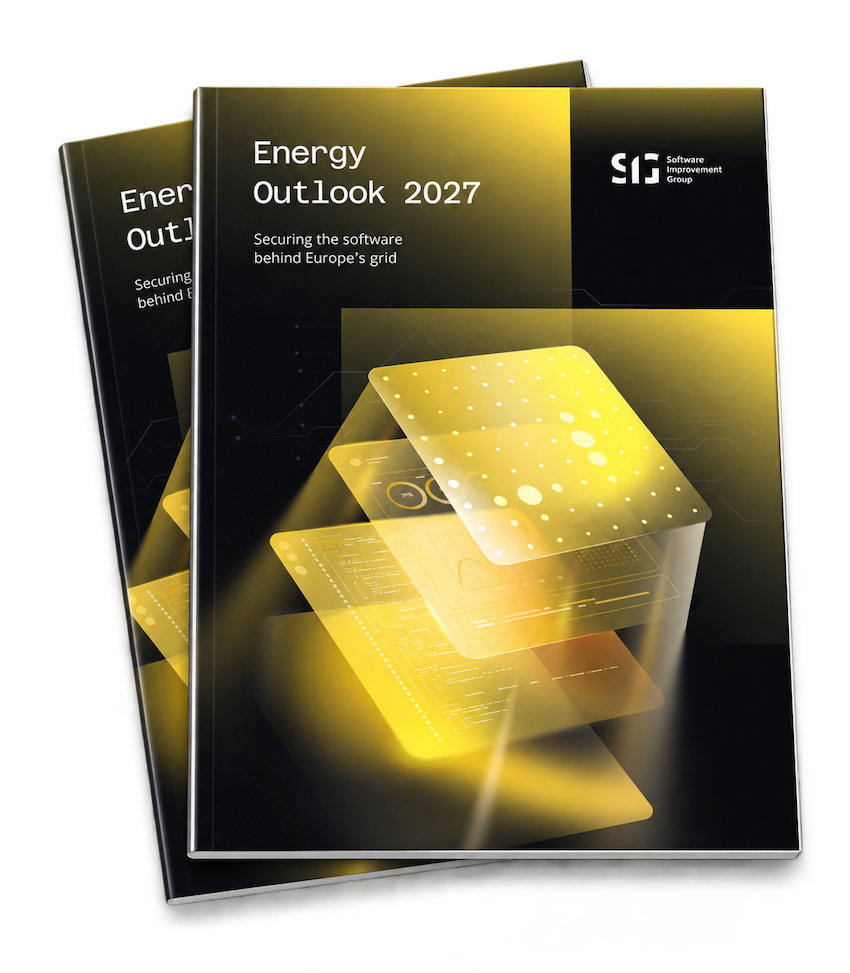
Energy Outlook Report 2027 cover mockup

Trusted by

Alliander EDSN Eneco Essent Stedin
The 2027 pattern

AI accelerates whatever discipline already exists.

AI compounds whatever discipline an organization already has. Where quality is measured and managed, AI accelerates delivery. Where it isn't, AI accelerates debt, cost, and exposure at the same speed. Six chapters show where that pattern already appears in energy software.

Chapter 01 — AI coding

3.7% of energy production code is AI-generated

That's above the 1.9% global average. AI-generated code also carries roughly double the security risk violations of human-written code.

Chapter 02 — Technical debt

€870,000 per system, per year

The developer time recovered by moving a system from 2-star to 4-star maintainability. Systems with lower code-level technical debt can show up to 72% stronger security compliance.

Chapter 03 — Maintainability

77.3% of energy code volume sits below the recommended threshold

Against 86% of code globally. The average energy system scores 3.2 stars, level with telecom.

Chapter 04 — Security

Attacks on grid-connected wind and solar sites are no longer hypothetical

The utilities sector is under attack, AI generated code contains 2x as many security vulnerabilities. The risks must be mitigated.

Chapter 05 — Architecture

34.4% of energy code volume scores below our recommended architecture rating

This is a major barrier to change in the agentic age. Agentic AI works best in robust architecture.

Chapter 06 — AI systems engineering

72% of AI systems score below the maintainability threshold

Just like a well-built house is easier to renovate, a well-structured codebase supports safe, efficient development over time.

“

The findings that follow come from SIG's own benchmark data, set against the best independent research available. Some of it is encouraging. Much of it should motivate action. All of it is meant to help you go faster — responsibly.

Luc Brandts, CEO of Software Improvement Group
Luc Brandts CEO, Software Improvement Group
Who it's for

Built for the leaders running the grid's software.

Each chapter speaks to a different seat at the table. Start with yours, then read the rest to see what your peers are working against.

Grid and operations leaders

Know which systems carry the most physical risk

Software failures in energy can cut power to millions. Find out where code-level and architectural debt sits in relation to grid operations.

Chapters 02, 04
CIOs and IT leaders

See where budget is locked up

Technical debt already consumes 21–40% of total IT spend across industries. Find out where that capacity sits in your estate.

Chapters 02, 03
CTOs and engineering leaders

Govern AI-assisted development

Understand what agentic coding costs in tokens, and where AI-written code needs a harness before it reaches grid-facing systems.

Chapters 01, 06
CISOs and security leaders

Close the gap at the grid edge

Distributed energy resources add software to the grid faster than most governance can follow. See where your open-source and remote-access exposure sits.

Chapter 04
Architecture and delivery leaders

Plan agentic AI across the IT/OT boundary

Legacy-system integration is one of the main blockers to agentic AI adoption. Map what has to change on both sides of the boundary.

Chapter 05
Free download

Get the Energy Outlook Report 2027

  • Six in-depth chapters covering AI coding, technical debt, maintainability, security, architecture, and AI systems engineering
  • Benchmark data drawn from more than 30,000 systems and over 400 billion lines of code
  • An energy-specific lens on the systems SIG analyzed over the past year, set against the best independent research available
  • Grid security in practice: what attacks on distributed energy infrastructure show about default credentials and remote access

This field is for validation purposes and should be left unchanged.
Name*
Privacy*

Read our methodology

This field is for validation purposes and should be left unchanged.
Name*
Privacy*

Watch Core in action

This field is for validation purposes and should be left unchanged.
Name*
Privacy*

Watch Axis in action

This field is for validation purposes and should be left unchanged.
Name*
Privacy*

This field is for validation purposes and should be left unchanged.
Name*
Privacy*

This field is for validation purposes and should be left unchanged.
Name*
What type of partnership are you interested in?*
Privacy*

Register for access to Summer Sessions

This field is for validation purposes and should be left unchanged.
Name*
Privacy*