Five levels for building software with AI, responsibly and at scale.
Download free framework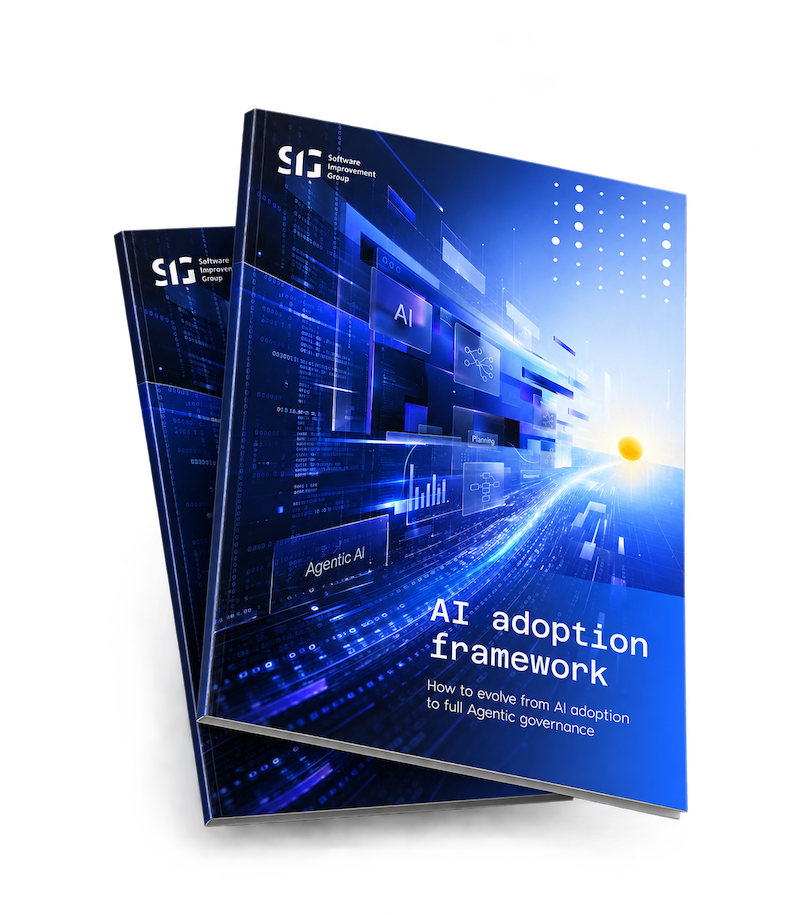
Trusted by architects and engineering leaders worldwide






Each level changes who is responsible for quality, which risks matter, and what governance you need. The tag under each level shows where the market is today.
Generates ideas, explanations, and code snippets.
Centrally provisioned coding assistants help write and improve software.
Agents plan, execute, and iterate.
AI across the full SDLC.
AI learns from its own behavior and fixes issues it observes at runtime.
Reaching enterprise AI maturity cannot be achieved through a single pilot project, tool, or purchase. Use this framework to assess your current position and collaboratively decide with your team on the next steps.

Four principles shape how organizations should approach AI in software development, and why governance can't be an afterthought.
Good foundations go faster with AI. Poor ones accumulate more problems, more quickly.
Models change. The harness around them (guides, context, sensors, monitoring) is what stays, compounds, and is yours. It is also what shapes the quality of what they produce
Unlike basic AI-assisted coding, agentic workflows operate autonomously across the entire pipeline. That demands a different way of working.
More AI requires proportionally stronger controls across six dimensions: cost, productivity, security, open source, architecture, and tech debt.
Each chapter speaks to a different seat at the table. Start with yours, then read the rest to understand what your peers are working against.
63% of organizations report no enterprise-level EBIT impact from AI. (McKinsey, The state of AI in 2026)
AI-generated code carries roughly double the security risk of human-written code. (SIG, State of Software 2026)
Agentic coding tasks can consume up to 1,000x more tokens than a standard code chat. (arXiv:2604.22750)
AI productivity gains of roughly 60% at 10,000 lines of code collapse by the time a system reaches 100,000 lines. (Stanford/Denisov-Blanch)
Two products, one backbone: Sigrid® Axis and Sigrid Core.
See how they fit together