The trends and insights telecom leaders need to govern what AI is building in 2027.
Download free report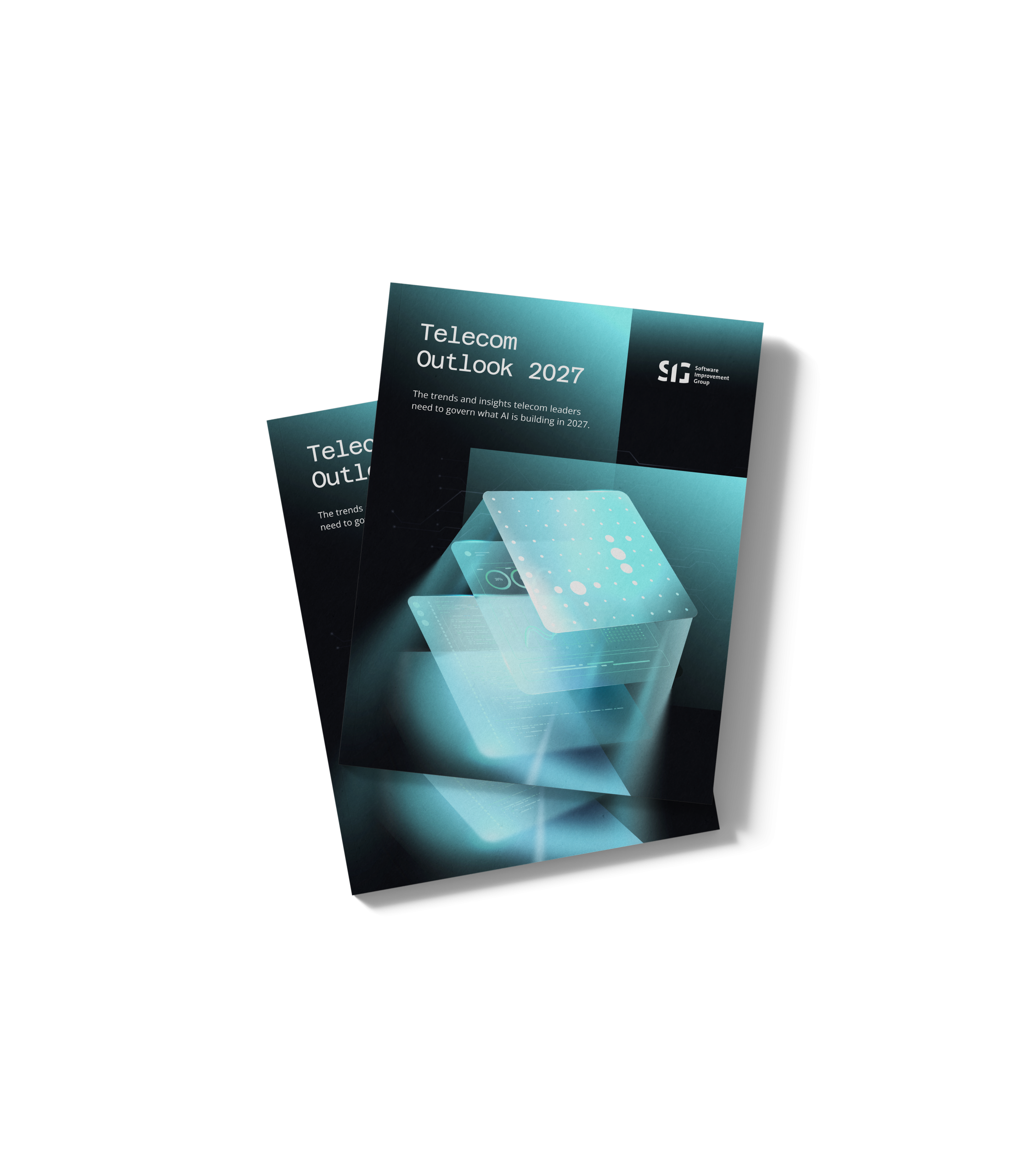
Trusted by




90% of technology professionals now use AI at work, and the volume of code entering organizations is rising faster than at any point in software history. The organizations capturing the productivity gains without inheriting the risk share one trait: they can see what they are running, measure quality continuously, gate it before code reaches production, and prioritize remediation by business impact. Six chapters break down where telecom stands today.
In SIG's experiment, AI-generated code carried roughly double the security risk violations of human-written code. Agentic coding tasks can consume up to 1,000 times more tokens than standard code chat.
That's what is recovered by moving a system from 2-star to 4-star maintainability. On January 14, 2026, a software defect took Verizon's network down nationwide for more than ten hours.
Telecom's architecture is the strongest of any industry we benchmark. The systems are well-structured, but the code inside them is in poor shape.
Open-source health is the weaker side: 84.1% of telecom code volume sits below the recommended rating, the highest share of any industry we benchmark. Across SIG's benchmark, the average system carries 20 critical security findings.
A Nokia-commissioned survey found 98% of operators need to modernize their BSS to enable new 5G services. Gartner predicts over 40% of agentic AI projects will be canceled by the end of 2027.
Roughly 1.5% of enterprise systems in production qualify as AI systems. Deutsche Telekom and Telenor are reported to have agentic AI live for OSS/BSS.
The argument is for closing the gap between the pace of AI adoption and the legacy reality underneath it, rather than layering more of one on top of the other.

Each chapter speaks to a different seat at the table. Start with yours, then read the rest to understand what your peers are working against.
Deloitte estimates technical debt accounts for 21% to 40% of an organization's total IT spending. In telecom, 84.3% of code volume sits below the recommended maintainability rating.
Chapters 02, 03Agentic coding tasks can consume up to 1,000 times more tokens than standard code chat. See what AI coding costs, and where AI output needs a harness before it reaches production.
Chapters 01, 06Telecom's open-source health is the weakest of any industry we benchmark. See where AI-generated and open-source code is carrying more risk than your review process can catch.
Chapter 04Telecom's architecture is the strongest we benchmark, yet operators still name legacy BSS/OSS platforms as a leading obstacle. See what it takes to modernize that layer alongside the agentic rollout.
Chapter 05