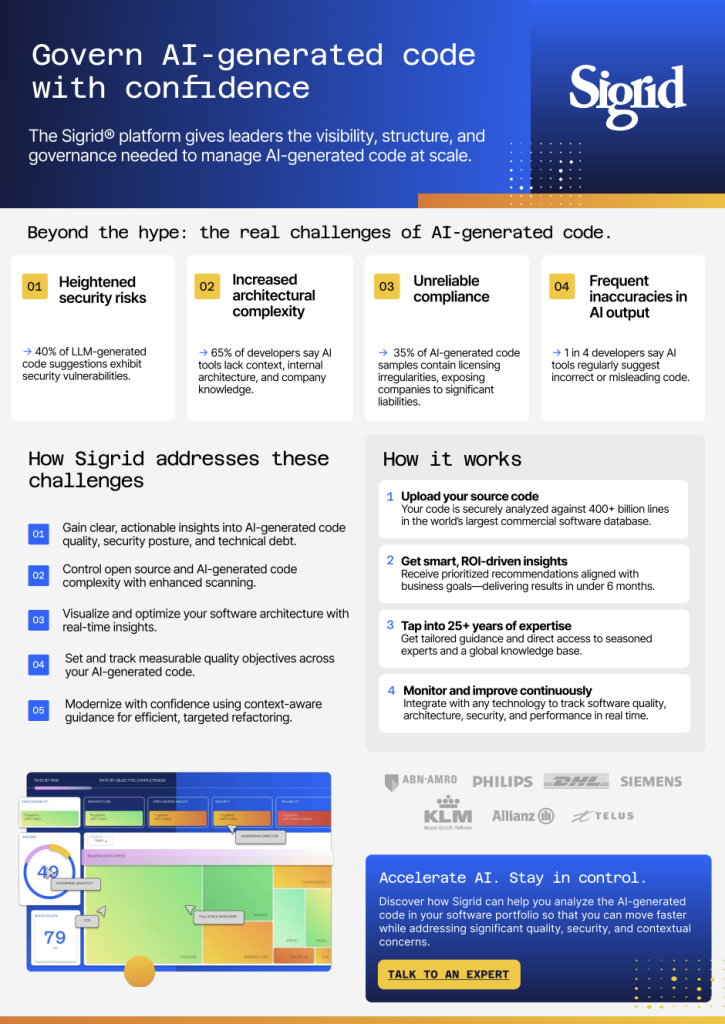
Gain the visibility, structure, and governance needed to manage your AI-generated code at scale
AI coding assistants make unexpected mistakes, lack full system and architectural context, and rely on pattern-based association rather than true understanding.Â
AI coding assistants can introduce serious security risks because AI coding assistants make unexpected mistakes, or can even hallucinate components—like made-up package names—which attackers can exploit.Â
Next, AI coding assistants are trained on vast datasets, which may include insecure coding patternsÂ
In addition, because AI lacks awareness of your architecture and policies, it can accidentally bypass security protocols or introduce unsafe dependencies.
AI code assistants can generate large amounts of functional code quickly, but this code may contain shortcuts, inefficiencies, or a lack of adherence to best practices if not carefully reviewed. This can lead to more costs through increased technical debt, slower development cycles, and higher maintenance expenses.
Even experienced developers find it hard to distinguish AI generated code from human-written code and “achieve only about 47% accuracy”–slightly worse than flipping a coin. (MDPI)
You can’t control what you can’t see. How do you evaluate the effectiveness of AI assisted coding?
Enterprises need to understand where AI coding assistants are being used within their software portfolio, the volume of AI-generated code, and the specific tools and developers involved in utilizing these assistants.Â
Â
AI coding assistants can generate code that falls under restrictive open-source licenses. If your organization incorporates that code without complying with the license terms, you may face legal disputes or be compelled to release proprietary source code under an open-source license.
Know exactly what AI code exists and where it creates risk
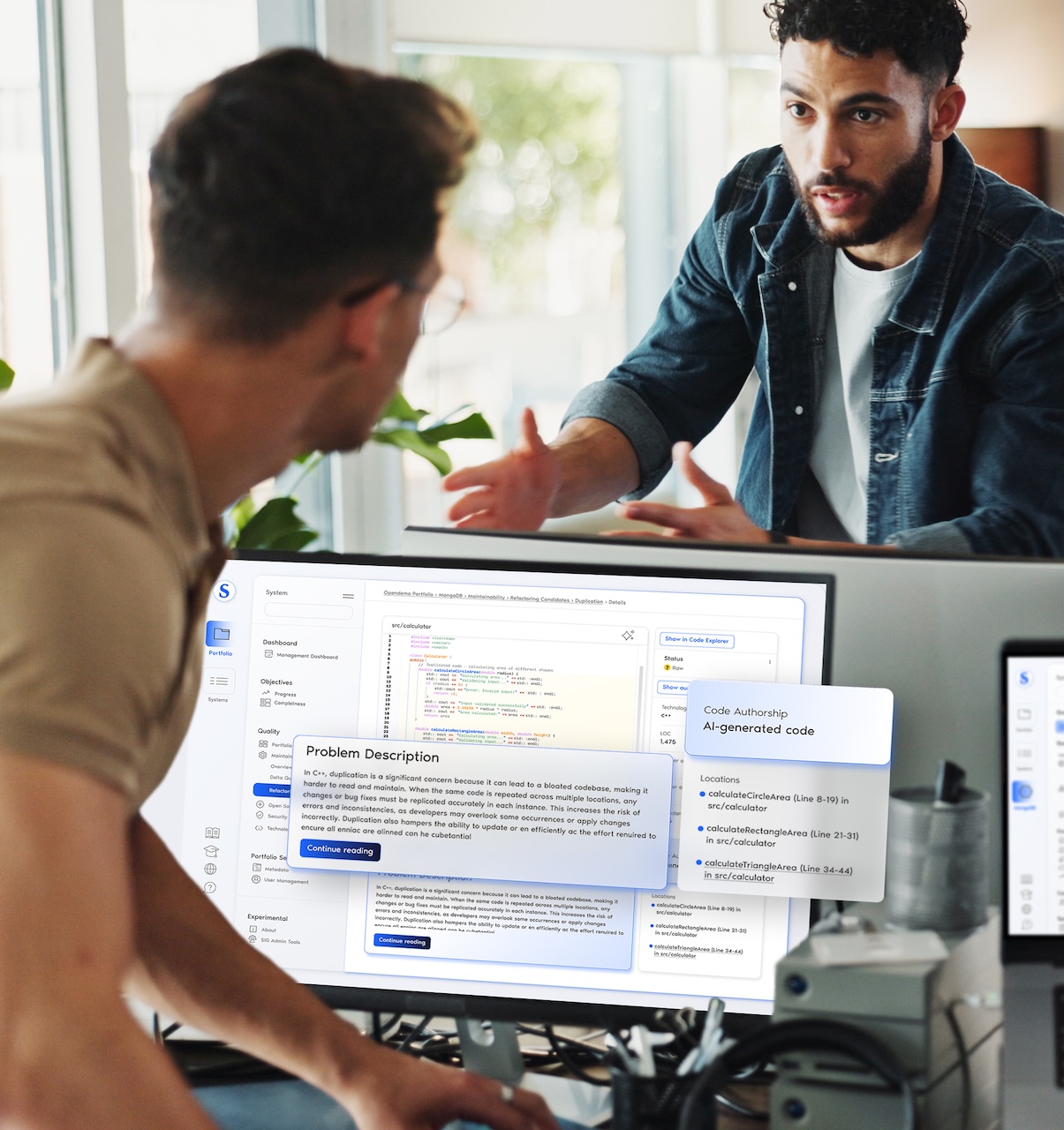
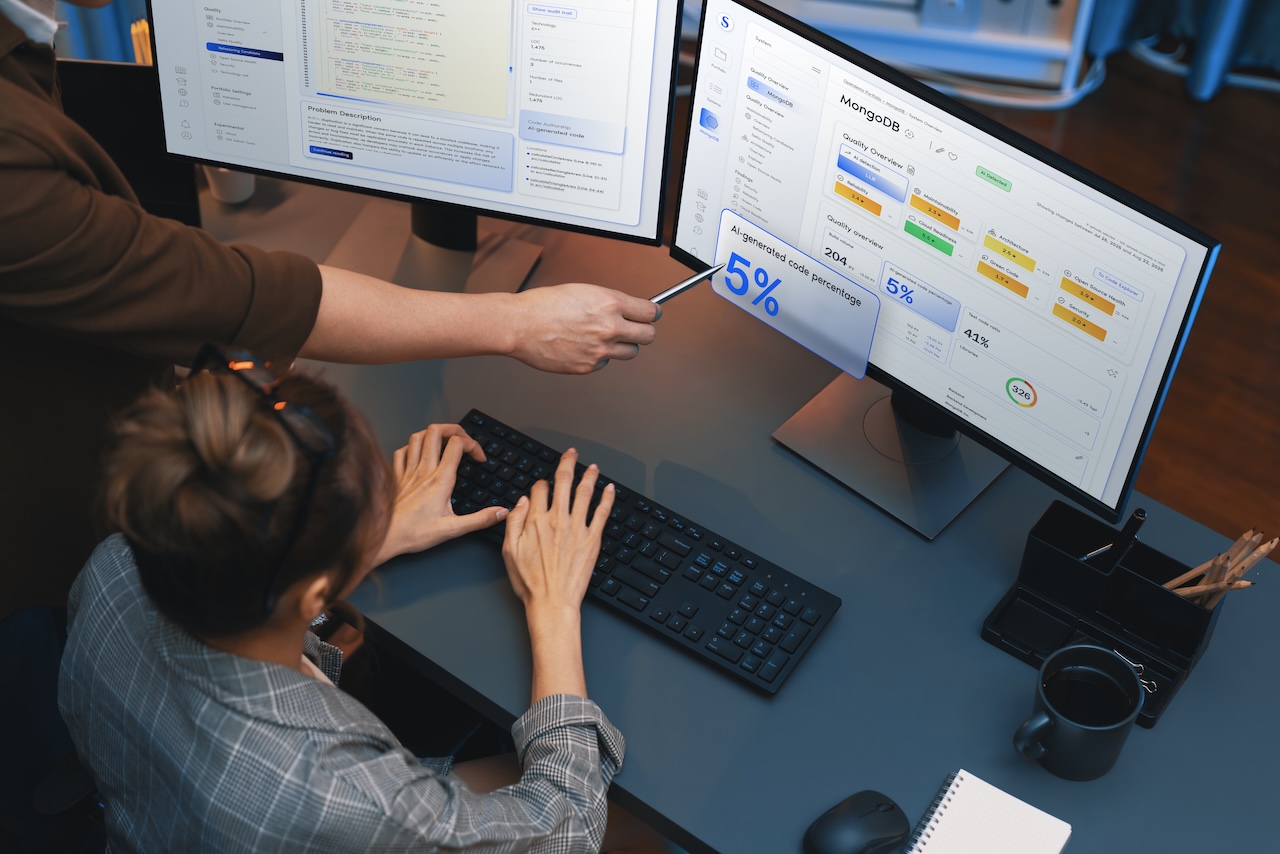
Identify and track AI-generated code across your portfolio with precision, and gain complete visibility into where and how it’s being used.
Ensure AI-generated code maintains the same standards as human-written code
Prevent AI code from becoming technical debt. Benchmark against leading standards and leverage the world’s largest database.
Enable AI to better understand your architecture
Get architectural guidance that helps AI-assisted modernization stay aligned with your system design so you don’t have to worry about AI’s lack of context.
Boost development productivity and stay in control
Use measurable standards for AI-generated code quality so that you can speed up instead of having flawed AI-code slow you down.Â
Boosts productivity and stay in control
Add quality and security checks to your assistant
Identify AI code across your portfolio
Provide the context that AI lacks
Know where you stand and where to improve
Assess critical software systems
AI coding resources
AI-generated code often contains hidden issues—such as security vulnerabilities, licensing conflicts, and architectural inconsistencies. AI tools lack context about your internal codebase, architecture, and business rules, which can result in hard-to-maintain systems and increased technical debt. Without oversight, productivity gains can quickly be outweighed by rework and risk.
AI-generated code introduces serious security risks because it’s often trained on flawed or outdated public code. It may include insecure coding patterns or even hallucinate components—like made-up package names—which attackers can exploit.
In addition, because AI lacks awareness of your architecture and policies, it can accidentally bypass security protocols or introduce unsafe dependencies.
LLMs can generate and even help review code—but they’re fundamentally limited. They rely on associative, pattern-based reasoning, which makes them fast but not always accurate. They can miss critical flaws because they don’t have full system context or understanding of your architecture. That’s why you need deterministic analysis tools and expert reviews to properly govern AI-generated code.
AI coding assistants hold great promise for accelerating software development and modernizing legacy systems. However, they also introduce significant challenges related to code quality, security, legal issues, and efficiency. Enterprises adopting these tools need comprehensive solutions to manage these risks effectively.
Whether formally allowed or not, most developers are already using AI coding assistants like GitHub Copilot or ChatGPT to some extent. Even in organizations that discourage it, developers often find ways to use these tools because they significantly speed up tasks like writing test code, generating boilerplate, or exploring unfamiliar code.
AI-generated code is difficult to distinguish from human-written code, making it challenging to track its usage across the software portfolio.
Vibecoding refers to a style of AI-assisted development where the user builds software by writing natural language prompts instead of writing code manually.
This approach sits at the far end of the AI coding spectrum. It’s often used for quick prototyping but is not suited for production environments, especially in complex systems. That’s because vibecoding typically lacks essential software engineering principles like architecture, reuse, testability, and encapsulation.
We see that enterprise and government clients rarely use vibecoding beyond experimentation, precisely because of these limitations. It can be fun and enabling, but without guardrails, it introduces significant risks.

An MCP (Model Context Protocol) server extends the capabilities of a large language model (LLM) by allowing it to execute external code or connect to external tools. This means an LLM can accomplish tasks that go beyond what it can do on its own—such as analyzing real code, running computations, or integrating with other systems.
Sigrid’s MCP server connects large language models (LLMs) directly to Sigrid’s software analysis engine, allowing models to retrieve deterministic, fact-based insights about software quality, risks, and vulnerabilities.
Instead of relying on probabilistic pattern matching alone, the LLM can query Sigrid through the MCP server to obtain real, data-driven results about the code being analyzed.
The MCP is integrated with AI Coding Assistants. Some IDEs are AI Coding Assistants (e.g. Windsurf, Cursor), some IDEs have plugins for AI Coding Assistants (e.g. VSCode with the Github Copilot plugin, JetBrains). Most IDEs have options today for integrating with some AI Coding Assistant and most AI Coding Assistants support MCP.
Can it connect to any IDE? this depends on the AI Coding Assistant.
If you have questions that aren’t covered here, feel free to reach out. We’re always happy to help you with more information or clarifications.