
How to Measure Code Quality
In this article
Summary
Code quality is not measured with a single score or one isolated tool. If you want a reliable view of software quality, you need a small set of objective indicators, clear interpretation rules, and a repeatable process for tracking changes over time.
In practice, the best approach is to measure and monitor code quality across maintainability, testing, security, and standards compliance. That gives engineering teams useful technical feedback and gives IT leaders a fact-based view of risk, cost, and improvement priorities. For a clear overview of what to measure and why it matters, see code quality and maintainability.
Start with what “good code” means in your context
Before you choose metrics, define what quality should support. In most organizations, code quality matters because it affects:
- Maintainability – how easily the code can be understood, changed, and extended
- Reliability – the ability of the system to perform without failure under specified conditions
- Security – how exposed the software is to vulnerabilities and unsafe patterns
- Delivery speed – impact on development velocity or time-to-market
- Cost and governance – how much technical debt increases maintenance effort and portfolio risk
This matters because code quality is measured to support decisions, not just to produce dashboards. A useful measurement system should help you identify where risk is concentrated, where refactoring is justified, and where engineering capacity is being lost to avoidable complexity.
Measure code quality with a balanced set of metrics
If you are asking how code quality is measured in a practical way, the answer is usually a combination of metrics rather than a single benchmark.
The highest-value metrics tend to fall into four groups.
1. Maintainability metrics
Maintainability is one of the clearest indicators of long-term code quality. It reflects whether a codebase can be changed safely and efficiently as requirements evolve.
Useful maintainability measures include:
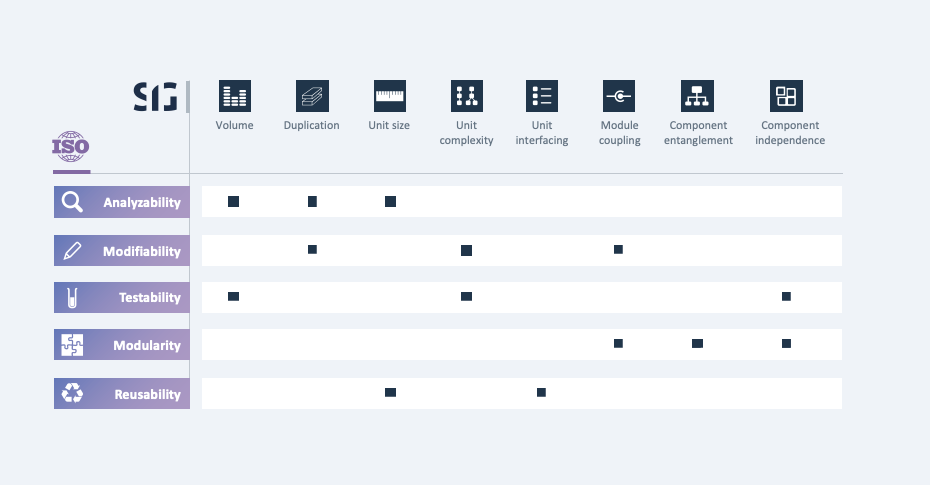
- Complexity – high cyclomatic complexity often signals code that is harder to test, reason about, and modify
- Duplication – repeated logic increases maintenance effort and raises the chance of inconsistent fixes
- Coupling – tightly connected components are harder to change in isolation
- Unit size – oversized methods, classes, or modules often reduce readability and increase defect risk
- Volume – large code units can indicate growing structural problems when combined with other signals
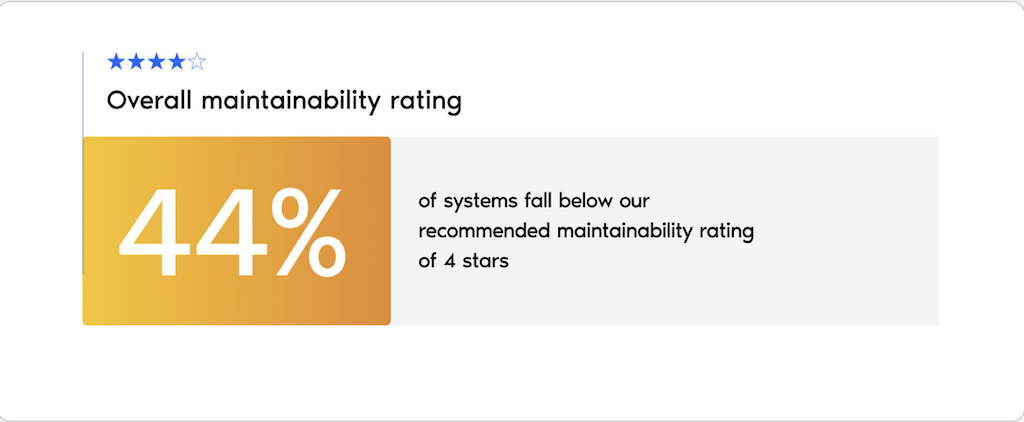
These source-code facts are especially useful because they are measurable, comparable over time, and closely linked to future maintenance cost. A maintainability model can combine them into a more interpretable view than raw metric lists alone. For example, the Maintainability Model (2024 update) explains a standardized 1 to 5 star scoring approach based on measurable source-code properties such as duplication, complexity, coupling, unit size, and volume.
2. Testing and defect detection metrics
Testing metrics help you understand how well the code is protected against regression, but they need careful interpretation.
The most common metric is test coverage, which shows how much of the code is executed by automated tests. Coverage is useful because low coverage often points to untested change risk. But high coverage does not automatically mean high quality. Code can be executed by tests without being meaningfully verified.
When measuring code quality, look beyond a single coverage percentage and consider:
- Coverage trends over time – whether protection is improving or degrading
- Coverage of critical components – whether the most important or risky systems are tested well
- Defect density – the number of issues relative to the size of the codebase
- Defect recurrence – whether similar problems reappear in the same parts of the system
If you only track coverage, you may miss the real problem. Strong measurement links testing indicators to actual defect behavior and change risk.
3. Security quality metrics
Security is part of code quality, not a separate concern. A codebase with structural weaknesses, unsafe coding patterns, or unresolved vulnerabilities carries higher operational and compliance risk.
Relevant security measures often include:
- Known vulnerabilities – the number and severity of detected weaknesses
- Security rule violations – insecure patterns found by automated analysis
- Exposure in critical systems – whether risk is concentrated in high-impact applications
- Security trend data – whether the risk profile is improving release by release
Security measurements become more valuable when interpreted alongside maintainability. Complex, tightly coupled, poorly tested code is generally harder to secure and slower to remediate.
4. Standards and governance metrics
Code quality also depends on consistency. A codebase that ignores agreed standards becomes harder to review, maintain, and govern at scale.
That is why many organizations track:
- Coding standards compliance – adherence to naming, structure, and implementation conventions
- Policy violations – breaches of internal engineering or security rules
- Technical debt indicators – measures that show how much future effort is being created by current shortcuts
For enterprise teams, these metrics are often more valuable when viewed at system or portfolio level rather than file by file. That broader view supports prioritization across applications, teams, and investment decisions. For a step-by-step framework for setting metrics, baselines, and governance, see the Software Quality Management Guide.
How to check your code quality in practice
If you want to know how to check your code quality consistently, use a repeatable workflow instead of one-off reviews.
- Choose a small core metric set. Start with maintainability, testing, security, and standards compliance.
- Measure automatically from source code. Automated analysis improves consistency and reduces subjectivity. Sigrid’s code quality analysis shows how maintainability is measured and how improvements are tracked over time.
- Track trends, not just snapshots. A declining trend is often more important than one isolated score.
- Assess at multiple levels. Review results by component, system, and portfolio to avoid local blind spots.
- Use thresholds carefully. Thresholds are useful for governance, but they should support decisions rather than become the goal themselves.
- Pair metrics with engineering judgment. Some qualities, such as conceptual clarity and appropriate design choices, still require human review.
This balanced approach avoids a common mistake: treating code quality as if it can be fully reduced to one number. Measurements are strongest when they provide structured evidence for discussion, prioritization, and action. For common pitfalls and how to build a reliable scoreboard, watch our software quality monitoring webinar replay.
What good code quality measurement looks like
A mature measurement approach has a few clear characteristics:
- Standardized – the same rules are applied consistently across systems
- Repeatable – measurements can be reproduced over time
- Comparable – results can be benchmarked across applications or portfolios
- Actionable – findings point to improvement priorities, not just abstract scores
- Independent – the interpretation is grounded in objective evidence rather than local opinion alone
This is particularly important in larger organizations, where leaders need portfolio-wide visibility instead of isolated team-level opinions. Standardized software analysis based on recognized models and source-code measurements makes it easier to compare systems, identify outliers, and prioritize investment where improvement will have the highest impact.

Common mistakes when measuring code quality
- Using one metric as the whole answer – no single metric captures maintainability, reliability, and security together
- Rewarding the metric instead of the outcome – teams may optimize for the score rather than the software
- Focusing only on low-level code issues – system-level and portfolio-level patterns matter too
- Ignoring context – a metric has different meaning in a stable core platform than in an early-stage experimental component
- Skipping trend analysis – direction of change often matters more than the absolute number
These mistakes are one reason code quality measurement should support governance, not replace judgment.
From measurement to improvement
Measuring code quality is only valuable if the results change decisions. Once you have reliable data, you can use it to identify high-risk systems, target refactoring where it reduces cost and delivery friction, strengthen security posture, and create a fact-based roadmap for improvement.
For organizations that need a standardized view across multiple systems, software analysis platforms and expert assessment services can help turn raw code measurements into consistent governance. SIG supports this with Sigrid for portfolio and system-level code quality analysis, alongside standardized software quality management based on ISO/IEC 25010 and ISO/IEC 5055. For how measurement connects to improvement cycles and stakeholder reporting, see software quality management explained.
FAQ
It’s the degree to which software can be modified effectively and efficiently to improve it, correct it, or adapt it to change. It’s measured on a scale, not a yes/no property.
Track structural metrics (modularity, duplication, complexity), testability, and change stability. Benchmark them against an external dataset, then govern improvements over time.
None in practice. Build quality is our plain-English term for maintainability. It rolls up the sub-characteristics into an actionable rating your teams can use.
Stronger build quality makes it easier to apply and maintain security controls and reduces change risk. In our data, systems with above-average build quality are twice as likely to meet higher security compliance levels.