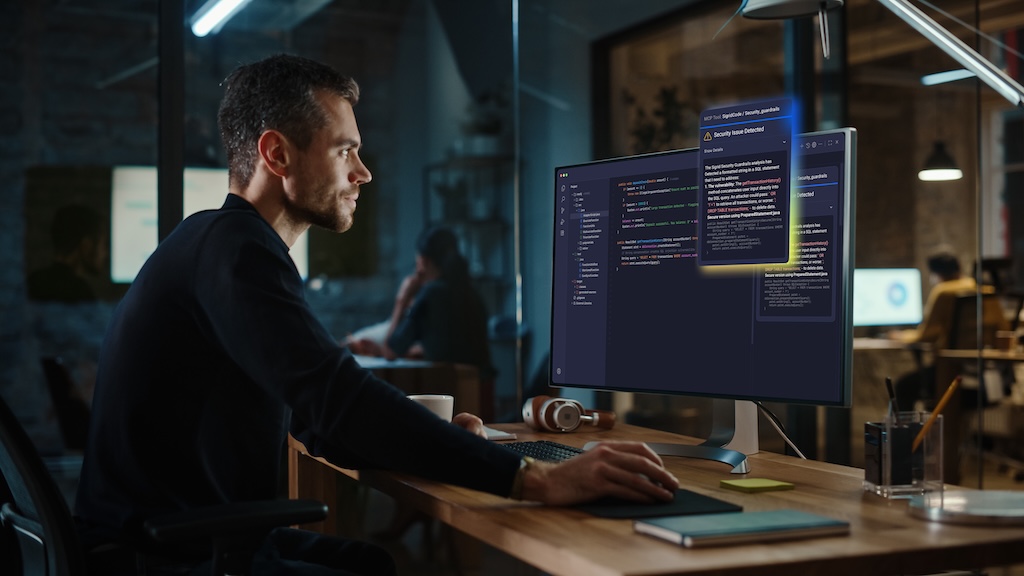
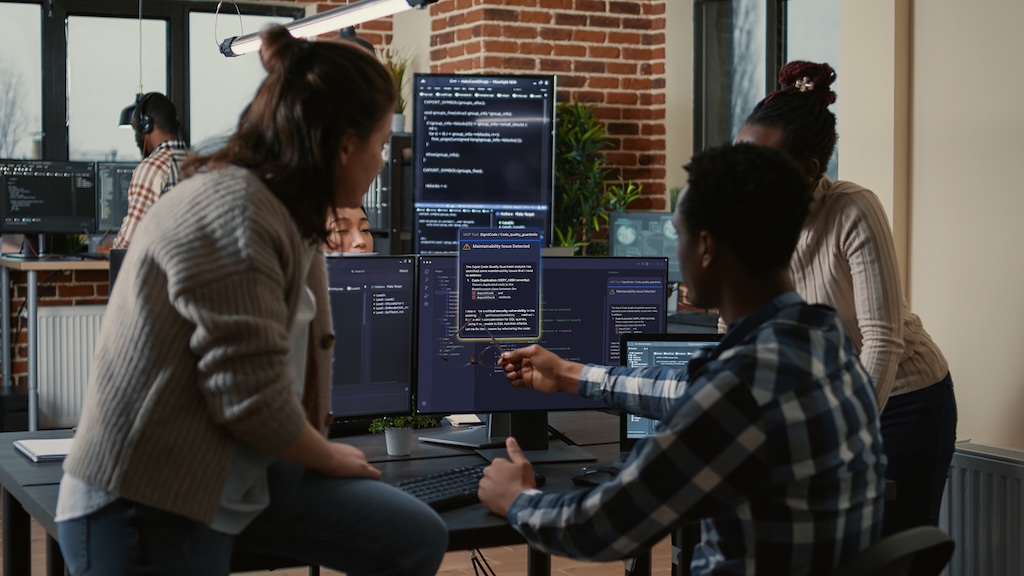
Sigrid® MCP checks maintainability and security in the IDE, as code is generated.
AI assistants speed up development. But as coding agents start producing more code with less manual oversight, human review alone becomes harder to scale. Through Sigrid® MCP, you can avoid maintainability issues directly in the IDE.
AI coding assistants and agents can produce code quickly. That makes early security checks more important. With Sigrid® MCP, teams can identify vulnerabilities as code is generated and address them before they move further downstream.
AI assistants and coding agents can generate and review code quickly. As they take on more of the workflow, fast, objective checks become more important. Sigrid® MCP returns feedback on maintainability issues, security vulnerabilities, and other quality signals within seconds, so developers can act on the findings quickly and teams stay in control.
Relevant resources
LLMs, AI coding assistants, and AI agents can generate and even help review code—but they’re fundamentally limited. They rely on associative, pattern-based reasoning, which makes them fast but not always accurate. They can miss critical flaws because they don’t have full system context or understanding of your architecture. That’s why you need deterministic analysis tools and expert reviews to properly govern AI-generated code.
AI holds great promise for accelerating software development and modernizing legacy systems. However, they also introduce significant challenges related to code quality, security, legal issues, and efficiency. Enterprises adopting these tools need comprehensive solutions to manage these risks effectively.
MCP stands for Model Context Protocol, an open standard that allows AI models (LLMs) to interact with and use external data sources and tools, acting like a "USB-C port for AI".
Sigrid MCP integrations can be used to leverage Sigrid’s capabilities from AI Coding Assistants, Agents and other MCP-based LLM tools.
The Sigrid Guardrails MCP integration enables AI coding assistants and LLMs to leverage Sigrid’s comprehensive code analysis capabilities during code generation. By embedding Sigrid directly into the AI agent workflow, this integration ensures that both newly generated and existing code is automatically evaluated for security vulnerabilities and quality issues.
This proactive approach allows AI coding agents to autonomously identify and resolve code issues in real-time, preventing quality problems at the point of generation rather than discovering them later in the development cycle through build pipeline failures or downstream processes
An MCP server is a way to extend the capabilities of a large language model (LLM) by supplying it with the possibility of executing external code to accomplish tasks that a single LLM model alone couldn’t.
Very simple example: Let’s assume that we want an LLM to analyze code for security vulnerabilities.
If you just ask a frontier model, like Sonnet 4, “What are the security vulnerabilities in this snippet?”, what happens is that the model will look at the code, and based on many, many similar patterns it has seen in its training process, it will combine those patterns with information about common security vulnerabilities (eg. a SQL injection) and the result will be a “stochastic assessment” of the security vulnerabilities.
While this works extremely well in a huge majority of cases, the obvious limitation is that it’s not truly deterministic. It’s all pattern-matching at a giant scale.
This is where the concept of an MCP server comes in!
What if there existed a mechanism that could: read a code snippet, send the code snippet to be analyzed by a deterministic tool, like Sigrid, and return output to the LLM, so that the LLM itself could really know the actual vulnerabilities in the code?
Well, this is exactly what we can do with our MCP server.

The MCP is integrated with AI Coding Assistants and Agents. Some IDEs are AI Coding Assistants (e.g. Windsurf, Cursor), some IDEs have plugins for AI Coding Assistants (e.g. VSCode with the Github Copilot plugin, JetBrains). Most IDEs have options today for integrating with some AI Coding Assistant and most AI Coding Assistants support MCP.
The currently supported technologies are:
Visit the Technology Support page for more details on supported technologies.
In agentic workflows, the model is not only generating code. It can use tools, access systems, and complete multi-step tasks. MCP gives coding assistants and agents a standard way to connect to those tools and sources of context, which makes it easier to add checks, controls, and trusted data into the workflow.
A coding agent is the system that plans and carries out tasks. MCP is the protocol that lets that agent connect to external tools, data, and workflows. In practice, MCP is part of the infrastructure that makes agentic coding useful and governable.
Coding agents can generate and update code quickly, but speed alone does not guarantee maintainability, security, or architectural quality. Objective checks help teams assess AI-generated code against clear standards instead of relying on the model’s confidence or pattern matching alone.Default description