SIG publishes findings from collaborative LETSGO Project on green cloud efficiency

Amsterdam, 30 September 2025 – Software Improvement Group (SIG) has released a new report summarizing key findings from the LETSGO Project (2023–2025), a collaborative initiative funded by the Rijksdienst voor Ondernemend Nederland (RVO).
The project brought together leading industry and academic partners to tackle one of the most urgent challenges facing digital infrastructure today: Reducing the energy consumption of cloud software.
With cloud computing on the rise, energy usage has surged. Worldwide electricity consumption by data centers is projected to grow by 165% by 2030, fueled largely by AI and other compute-heavy technologies. Improving the energy efficiency of cloud systems has become a critical priority.
LETSGO’s findings demonstrate that software efficiency can play a significant role in improving cloud sustainability.
“Cloud adoption is nearly universal, yet its environmental footprint is skyrocketing. This research shows that by changing the way we design and run software, organizations can make measurable strides in reducing energy consumption, without compromising performance.” — Luc Brandts, CEO of Software Improvement Group
Key findings of the LETSGO Project
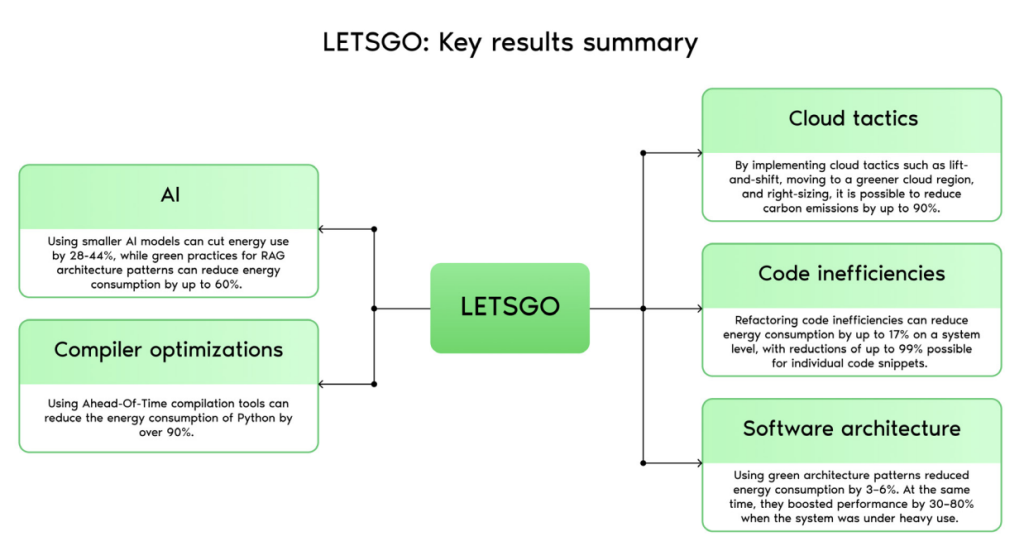
The LETSGO report provides evidence-based insights and practical strategies to reduce energy consumption in cloud environments. Key findings include:
- Artificial intelligence: Using smaller AI models can cut energy use by 28–44%, while green practices for Retrieval-Augmented Generation (RAG) systems can cut energy use by up to 60%.
- Compiler optimizations: Using Ahead-Of-Time compilation tools can reduce the energy consumption of Python by over 90%.
- Cloud Tactics: By implementing cloud tactics such as lift-and-shift, moving to a greener cloud region, and right-sizing, it is possible to reduce carbon emissions by up to 90%.
- Code inefficiencies: Refactoring code inefficiencies can reduce energy consumption by up to 17% on a system level, with reductions of up to 99% possible for individual code snippets.
- Software architecture: Using green architecture patterns reduced energy consumption by 3-6%. At the same time, they boosted performance by 30-80% when the system was under heavy use.
About the LETSGO Project
Improving cloud software energy efficiency is feasible when energy consumption is accurately measured, estimated, and integrated during the design phase. Prior research confirms this is achieved at academic and high-performance computing (HPC) levels, but these methods are not yet straightforward or practical enough for complex and dynamic cloud environments.
LETSGO united academic and industry leaders including Vrije Universiteit Amsterdam (S2 Group), SURF, Schuberg Philis, BonvinLab at Utrecht University, Imuno Therapeutics, the Sustainable Digital Infrastructure Alliance, and Innofunding.
Together, the consortium translated insights from controlled research environments into practical strategies for real-world cloud applications. More information about the different LETSGO members is included in the report.
Practical insights, not academic theory
The findings summarized in the report are intended as business-oriented insights for organizations seeking to improve the sustainability of their software.
While the research builds on strong academic collaboration, the report does not attempt to provide a complete or academically rigorous account of the work. For those seeking the technical detail, a full list of academic publications from the LETSGO consortium is available in the appendix.
Download the free report to explore the full LETSGO findings and learn how smarter software design can reduce energy consumption in cloud environments.