
Streamline business-IT alignment by setting custom IT objectives that support your company’s wider goals.


Set IT objectives on a portfolio, multi-system, or single-system level. This allows you to adjust targets realistically based on the individual characteristics of each system, simultaneously taking nuances into consideration while promoting standardization across your portfolio.
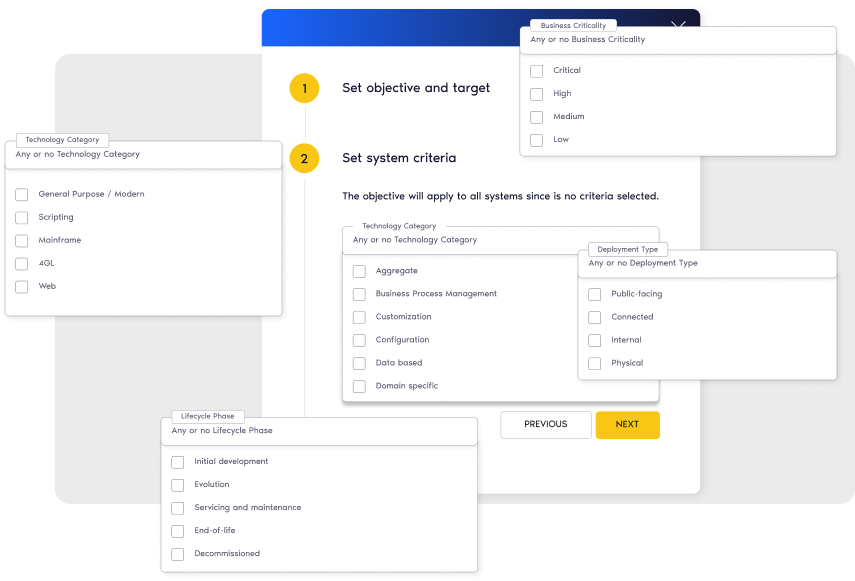
Define IT objectives based on attributes like the system's technology category, business importance, lifecycle phase, or deployment type to set priorities based on your unique business context.

Perform trend analysis of your portfolio and systems over time. This helps you gauge if software quality and other attributes are trending in the right direction to support your strategic IT planning.
Ensure your IT objectives directly support your overarching business strategy.
Encourages continuous improvement while fostering a culture of software excellence.
Address pressing issues before they escalate by monitoring risk-related IT objectives.
Set and share clear IT objectives that are understandable across IT and business stakeholders.

“Having a real-time view of our software portfolio allows us to build our roadmap on current data and ensure every decision is grounded in fact.”
“I love to work with the objectives that Sigrid offers, those actually make me work a little bit harder and grow even more.”
ortfolio Objectives in Sigrid allow you to set quality targets that apply across multiple systems in your portfolio, rather than configuring objectives individually for each system. As mentioned in our Sigrid Portfolio Objectives Documentation, this feature is "a gamechanger around monitoring quality with a good step towards management reporting." You can access Portfolio Objectives through the "Objectives" tab in your portfolio navigation, where you can configure objectives for all your systems at once.
Sigrid creates a shared understanding between all stakeholders on the IT landscape by providing clear, measurable quality standards. Portfolio Objectives take this further by letting you set organization-wide standards that connect technical debt to business risk and compliance requirements.
Yes! Sigrid's Portfolio Objectives support conditional targeting based on system metadata including technology category, business criticality, deployment type, and lifecycle phase. This means you can create rules like "All public-facing systems should have no libraries with known vulnerabilities above 7 CVSS" while having different standards for internal or legacy systems. This flexibility ensures your objectives are realistic and aligned with each system's business role.
Sigrid's security capabilities integrate directly with Portfolio Objectives to help you enforce vulnerability management standards across your entire portfolio. You can set objectives around third-party findings, open-source health, and security vulnerabilities. The platform tracks resolution times, shows trends in open versus resolved security issues, and provides both operational insight and governance oversight for management reporting.
In Sigrid, system-level objectives are specific targets set for individual applications, while Portfolio Objectives apply universally across multiple systems. When you set a system-level objective, it overrides the portfolio-level objective for that specific system. This gives you flexibility to have general organizational standards while allowing exceptions for systems with unique requirements or constraints.
Sigrid's Technical Monitor provides detailed insights that complement your Portfolio Objectives perfectly. You can drill down from portfolio-level compliance into specific system metrics to understand exactly why a system isn't meeting objectives. The metrics table shows you the underlying measurements - like cyclomatic complexity, duplication percentages, or security findings - that feed into your objective calculations. This makes it easy to prioritize which technical improvements will have the biggest impact on meeting your portfolio goals.
Absolutely! Sigrid's trend analysis capabilities work seamlessly with Portfolio Objectives. You can see how your portfolio compliance changes over time, track which systems are improving or declining against your standards and measure the effectiveness of your quality improvement initiatives. This historical view is crucial for demonstrating ROI on technical debt investments and showing management that quality initiatives are delivering measurable business value.
This feature in Sigrid's Portfolio Overview lets you see how systems are performing against their defined objectives rather than just looking at raw quality scores. It's particularly powerful because it shows your business-relevant progress - a system might have a 3-star maintainability rating but still be meeting all its objectives if those objectives are appropriate for its role and lifecycle stage. This view helps you focus on what matters for your organization's goals.
When you upload new code to Sigrid, the platform automatically evaluates it against your Portfolio Objectives and shows you immediately whether the changes help or hurt your compliance. You'll see objective status updates in your system dashboard, and any new violations or improvements are highlighted. This real-time feedback helps development teams understand the quality impact of their changes and make informed decisions about technical debt.
Sigrid's Portfolio Objectives create an auditable trail of your organization's quality standards and compliance status. You can generate reports showing which systems meet regulatory requirements, track remediation efforts over time, and demonstrate due diligence to auditors. The platform's objective-based reporting translates technical metrics into business language that compliance teams and auditors can easily understand, making it much easier to demonstrate that you're actively managing technical risk across your software portfolio.