
Access a real-time software architecture diagram and visualize, optimize, and innovate your software systems.

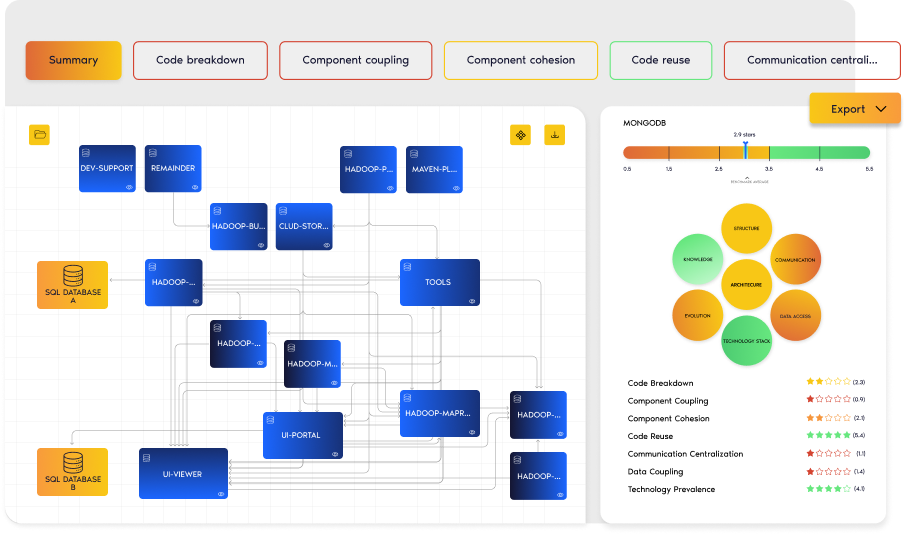
See every aspect of your software architecture—components, AI systems, subsystems, and dependencies, including undesirable ones—in one detailed software architecture diagram. Understand the real-time structure and interconnections within your systems for more informed decision-making.
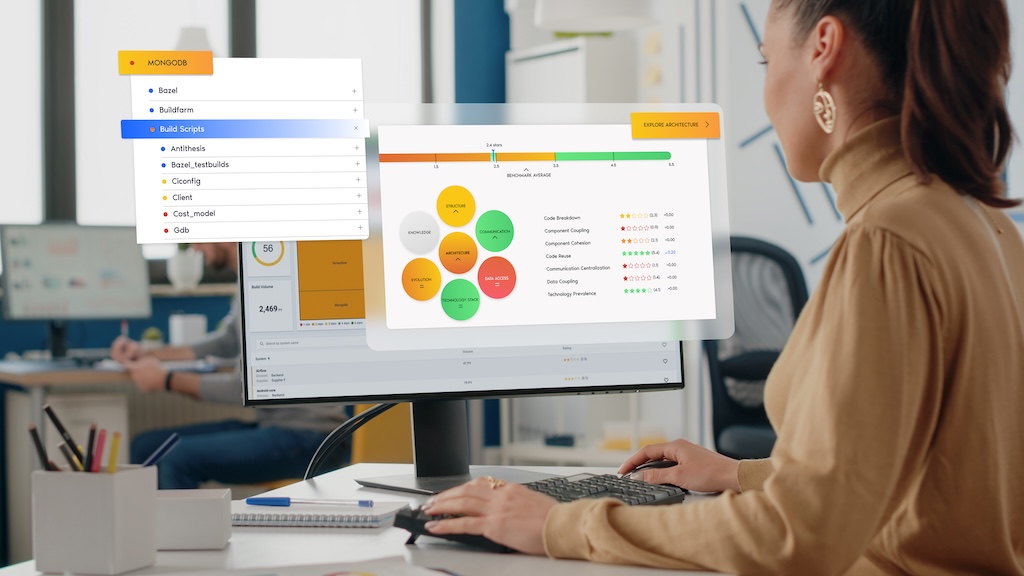
Sigrid evaluates how well your software architecture adapts to new requirements or technologies. This helps you manage change effectively and avoid legacy system issues—crucial for the long-term success of your business.


Sigrid breaks down your software architecture into components and subcomponents, helping you pinpoint the specific areas that require immediate attention. This allows you to improve your software architecture incrementally within your regular development cycles.
Sigrid offers extensive customization options through its configuration files, enabling you to define custom components, exclude files, or adjust dependency settings as needed. It also supports multi-repo systems, providing a unified architectural view across multiple projects or teams.
With the help of the Sigrid platform, we could implement the new architecture, ensure it was SaaS-ready, and further future-proof the system."
Software architecture refers to the fundamental structure and organization of a software system architecture. According to SIG's definition, it's "the structural design of a software system and refers to the way a given codebase is divided and grouped together based on responsibilities of the system, and the underlying dependencies between these responsibilities."
Key aspects include:
Software architecture patterns help solve common design problems and provide proven structures for organizing software systems.
Some key benefits include:
The software architecture design is set up according to the MVC model. The MVC model provides support for a modular and separate structure of the application architecture. It's worth noting that MVC is often used as a high-level organizing principle for entire applications or large components, which aligns more with the concept of a software architecture pattern. Design patterns, on the other hand, typically deal with smaller-scale problems within the code.
The line between software architecture and design patterns can sometimes be blurry. MVC influences both the overall structure of an application and how individual components interact, so you might see it referred to as both in different contexts. In practice, MVC is often implemented alongside other patterns.
It's also important to note that there are variations on MVC, like MVP (Model-View-Presenter) and MVVM (Model-View-View-Model), which are also considered software architecture patterns. These variations aim to address some of the limitations or specific use cases that developers encountered with traditional MVC.
SIG uses a model that maps quality attributes in software architecture to 10 system properties across 6 main categories:
These properties are measured through static code analysis and repository history analysis.
It's common to combine multiple software architecture patterns in large systems. For example, you might use a microservices architecture overall, with individual services implementing MVC internally. The key is ensuring the patterns complement each other and align with your software system architecture goals.
Software architecture design quality is available by default. Once you’ve published your system, you will automatically see an “Architecture” tab appear when you view your system in Sigrid.
You can use the scope documentation to customize the software architecture quality analysis for this system, if necessary.
Sigrid uses your anonymized repository history to calculate metrics on which code has been changed, and when those changes were made. These statistics do not contain personal information. In fact, if you use Sigrid CI, the developer names will be anonymized client-side, so before anything is published to Sigrid. You can find more information on Sigrid data usage in our Privacy Statement.
Git, which has over 95 percent market share. Supporting other version control systems would require an unreasonable amount of effort for the SIG infrastructure. However, clients can convert their repository to Git during their pipeline.
Examples:
Yes. This does require you to initialize the submodules as part of your build pipeline, but this is done automatically by basically all mainstream development platforms. If you are manually cloning your repository in your pipeline, use git clone --recurse-submodules to clone both the “main” repository as well as its submodules.
Teams working with Git will often use slightly different workflows: merge commits or squashing commits. We support both as part of our analysis. When using merge commits, we only count the “original commit” and not the merge commit itself, to avoid counting every change twice. When squashing commits, we analyze the squashed commit instead of the original commits, for the practical reason that we no longer have access to the original commits after they have been squashed.
SIG's model is unique in its focus on measuring software architecture consulting flexibility through code analysis. Unlike many theoretical models, it provides concrete, measurable insights based on the actual implemented software architecture in software engineering. It's designed to work across different software architecture patterns and can be applied consistently across an organization's entire enterprise architecture software landscape.