
Simplifying complexity: Rabobank’s IT transformation

About Rabobank
For 125 years, Rabobank has served as a cooperative bank, working to improve the prosperity and well-being of millions of people worldwide. Behind this ambition is a commitment to innovation and security. Rabobank’s IT environment is the backbone of its operations, providing the critical foundation for customer service and business growth across all regions.
The IT department oversees a highly distributed landscape, supporting everything from daily banking operations to advanced financial platforms. This scale and diversity make technology modernization a complex but essential priority.
According to the Finance Signals 2025 report, many financial services systems still run on legacy technology, creating complexity, slowing change, and making transformation more urgent than ever. For Rabobank, modernization means consolidating decades of systems into a unified, future-ready platform—without compromising reliability, security, or innovation.
How Rabobank reduced technical complexity and improved system stability
In an environment where system sprawl and technical debt can threaten both stability and innovation, clear visibility and expert guidance become essential. Rabobank chose Software Improvement Group (SIG) to help cut through this complexity with tools, objective insights, and actionable advice.
Modernizing IT systems in a global financial institution is no easy task, especially when those systems span decades, continents, and countless technologies. For Rabobank, this meant replacing a complex mix of legacy systems and homegrown solutions with the proprietary Murex platform while maintaining control throughout the process.
To succeed, Rabobank needed deep visibility into the structure and complexity of their systems, practical guidance to manage technical debt, and a way to drive simplification without slowing down transformation.
The challenge: Navigating complexity in a large, distributed IT landscape
In particular, Rabobank faced three key challenges:
- A highly distributed IT environment
Rabobank’s technology stack spans standard languages like Java and .NET, along with proprietary platforms such as Murex, making consistency and integration a constant challenge. - Varied teams and roles across multiple regions
Development teams are spread across the Netherlands, the UK, and India, each working within their own context, processes, and areas of expertise. - The need to align technical complexity with fast-changing business requirements
Rabobank must continuously balance architectural integrity and adaptability to meet evolving business goals across markets.
“One of the challenges is that every team thinks their position is different—which is true—but we can still learn something from each other, regardless of the technology stack we’re using.”– Harald Thoonen, Solution Architect, Rabobank
Solution: Transparent metrics and practical guidance across a diverse stack
Rabobank set out to find a partner that could bring real clarity to a uniquely complex IT landscape. With a non-standard stack—including proprietary platforms rarely seen outside the bank—they needed more than just off-the-shelf tools. SIG’s technology rose to the challenge, quickly mapping these custom platforms to industry standards and delivering actionable insights from day one.
“When we pushed for it and embarked on the journey, SIG’s tooling picked up those kinds of languages quickly… It helped us keep control of technical debt and identify where we needed to focus.”– Harald Thoonen, Solution Architect, Rabobank
Over the last five years, Rabobank has leveraged SIG’s assessments to guide both technical and functional improvements. This went beyond analyzing code to also questioning what components were doing, and whether they needed to exist at all.
Results: Simplifying complexity at scale
SIG’s partnership enabled three core outcomes: technology-agnostic analysis across all platforms (including both standard and proprietary systems); prioritization of the most critical areas, and increased alignment across distributed, multi-country teams through frameworks, tools, and visualizations that unified both technical and business stakeholders.
80% reduction in implementation effort and near-zero support incidents
A major milestone in the transformation journey was the creation of the “Essential Improvements” team. Tasked with tackling the most critical areas of technical debt and complexity, the team helped the organization reduce the effort required for key implementations by 80%, while support tickets dropped to almost zero.
“That underpinned quite well that having attention for technical debt—or even functional refactoring—you can benefit even while running toward the finish line.”– Harald Thoonen, Solution Architect, Rabobank
These results not only reduced disruption and operating costs but also helped maintain architectural integrity during a high-pressure consolidation program.
Making complexity visible: brick by brick
As part of the kickoff of this project, Rabobank created a massive 3D LEGO model that mapped out their system and business landscape. This helped internal stakeholders understand the true scale and entanglement of the existing architecture, something that’s often too abstract to grasp from diagrams alone.
“We put it in the entrance of the building… so that it really starts getting into the systems of people.” – Harald Thoonen, Solution Architect, Rabobank
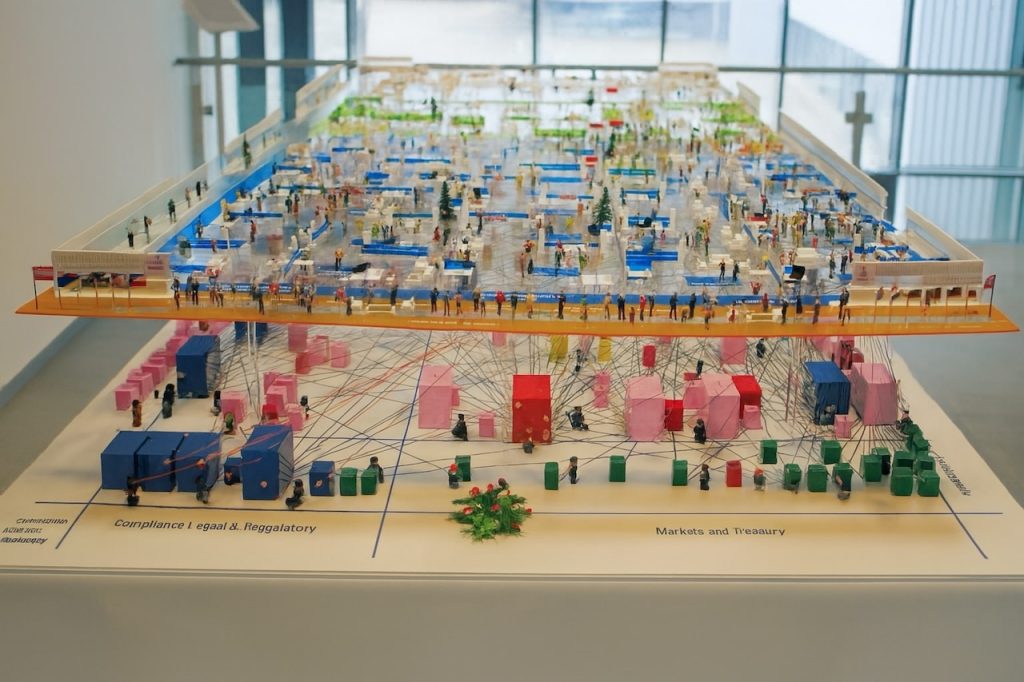
Disclaimer: This is an AI-optimized image of the 3D Lego Model at Rabobank’s office
The visualization supported executive buy-in for architectural change and helped illustrate the benefits of the target state: condensing 20–25 systems into a single platform. This bold goal, while risky, was made more manageable through structured refactoring and the insights provided by SIG.
Key results
80% reduction in implementation effort
→ Achieved by simplifying complex components through technical and functional improvements.
Support tickets reduced to almost zero
→ Focus on eliminating technical debt and stabilizing high-disruption areas.
Meaningful insights across both standard and proprietary technologies
→ SIG’s tooling adapted to platforms like Murex by mapping them to standard language models.
Maintained architectural integrity during high-pressure delivery
→ Refactored strategically instead of shortcutting quality
Increased alignment across distributed, multi-country teams
→ Supported by a central design board and practical architecture guidance from SIG.
Conclusion
Working with SIG enabled Rabobank to:
- Gain visibility into technical debt across both standard and proprietary technologies
- Simplify complex components both functionally and technically
- Reduce continuous implementation effort and minimize production incidents
- Maintain architectural integrity while replacing 25 systems with one
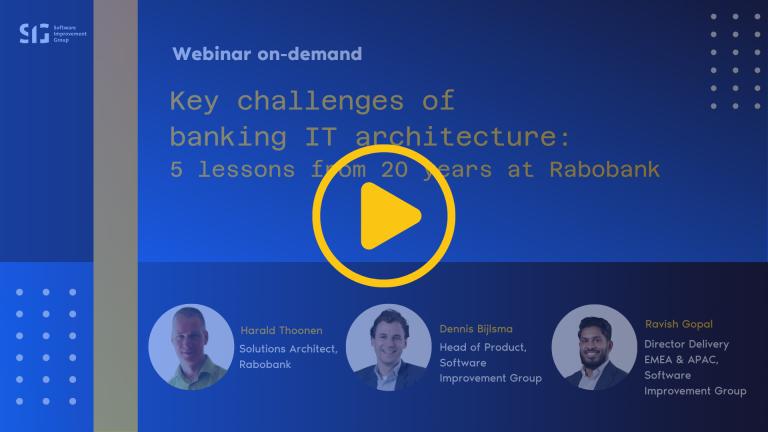
For a more in-depth discussion of how Rabobank tackled architectural complexity and technical debt in their large, distributed IT landscape, check out the full webinar.
Ready to modernize your IT landscape?
The average bank spends 75% of its IT resources on orchestration and control rather than innovation, limiting agility and scalability.
Software Improvement Group helps financial institutions shift their focus, simplifying complexity, reducing technical debt, and delivering measurable results.