
AI systems in energy: engineering the next frontier
In this article
AI isn’t just changing how we build software. It’s changing what software is.
For technology leaders in the energy sector—where reliability, safety, and compliance underpin everything—this marks a new engineering frontier.
AI systems have the potential to transform how we detect threats, predict maintenance, optimize operations, and support the energy transition. But that potential can only be realized when AI is treated with the same rigor and discipline as any other mission-critical system.
Why AI systems are different
Unlike traditional software, which follows pre-programmed rules, AI learns, evolves, and makes autonomous decisions.
According to ISO/IEC 5338 — co-developed by Software Improvement Group (SIG) — AI is classified as a software system with unique characteristics.
It can learn from data, adapt over time, and even perceive and act through capabilities like language, vision, or sound. That power also introduces risks:
- Bias
- Model drift
- Security vulnerabilities
- Limited transparency
- Maintainability issues
In short: AI systems don’t just execute logic. They interpret it. And in a sector built on predictability and trust, that interpretation must be engineered and governed with care.
The AI system maintainability crisis
Our own research reveals a concerning reality:
73% of AI and big data systems score below benchmark average in build quality, with an average rating that’s significantly lower than traditional software.
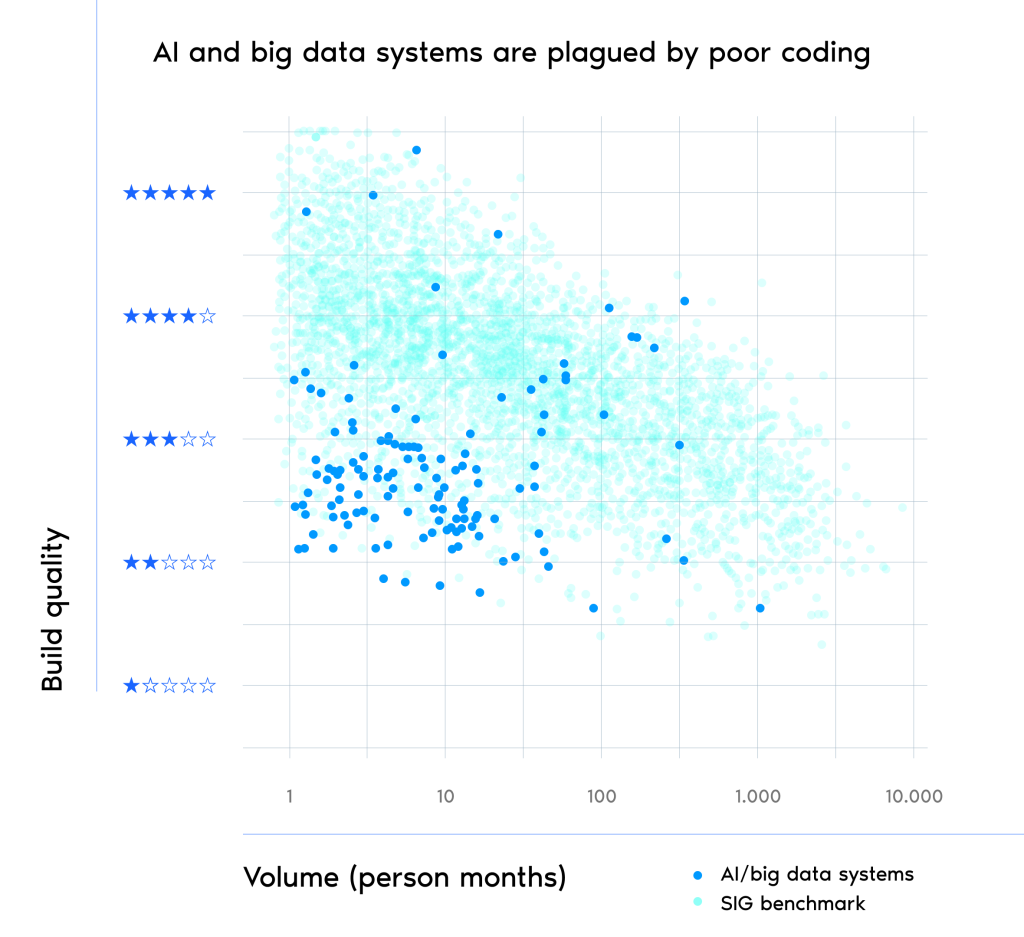
Why? Two main reasons:
- Complex, bloated code — AI systems often include long, unfocused code blocks that handle multiple responsibilities, making them hard to test or reuse.
- Lack of testability — AI systems typically contain just 1.5% test code, compared to 43% in traditional software. That means errors are harder to catch, and models risk becoming untrustworthy over time.
Architecture: the backbone of sustainable AI
As AI adoption accelerates, architecture matters more than ever. According to Dataversity, nearly 50% of organizations are modernizing their data architectures to support real-time analytics and AI/ML capabilities.
In the energy sector, this foundation is essential for:
- Seamless data integration
• Continuous model retraining
• Scalable AI deployment
• Faster, safer experimentation
The reality is simple. If your architecture isn’t ready, your AI systems won’t be either.
The engineering gap
Many energy organizations still treat AI as experimental — a lab project run by data scientists, not engineers. This often results in models that work in isolation but fail in production environments that demand reliability, security, and strict compliance.
Engineering robust AI systems means bridging data science and software engineering. It means treating AI like any other serious system: modular, maintainable, documented, secure, and testable.

From predictive grid maintenance to safer plant operations, AI is proving its value — but sustainable impact depends on strong engineering foundations.
Engineering AI systems for the energy sector
AI systems represent a powerful evolution of software: systems that learn, adapt, and improve. But their complexity introduces risks to security, reliability, and trust if not engineered with precision.
For CTOs and engineering leaders in energy, this means:
- Strong architecture capable of handling diverse real-time data
- Continuous validation and retraining to counter model drift
- Disciplined engineering practices across the entire AI lifecycle
- Clear governance and accountability for decisions made by AI systems
AI cannot remain a lab experiment. In energy, it must behave like any other mission-critical system.
From experiments to enterprise-grade AI: what energy leaders need to do next
AI is already delivering value across the sector — but value without engineering discipline quickly turns into operational risk.
Building reliable AI systems at scale requires combining:
- Software engineering best practices
- AI lifecycle governance
- Continuous validation
- Strong architectural foundations
Treating AI as a core capability is the only way to move beyond prototypes and deployments that don’t stick.