Table of Contents
Get an IT Portfolio Scan in time for 2026
Know where your software stands, how it compares, and where to improve
Book a callQuick Access to Resources
Reports, frameworks & checklists to get you ready for 2026
IT maturity framework
Discover the four-stage organizational IT maturity model and how it relates to AI adoption.
IT maturity self-assessment
Figure out where you stand and anchor your AI strategy to your current stage.
19 steps to AI governance
Evaluate your AI readiness: learn the steps for board members, executives, and IT leaders to implement AI with confidence.
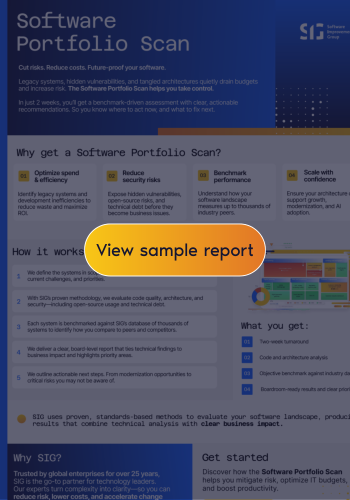
Software portfolio scan - sample report
Assess your IT portfolio to kick off 2026 planning with objective insights.
Companies are deep in 2026 planning — and CIOs are facing a year defined by AI governance, platform modernization, resilience, and sharper IT economics.
To help you prepare, we’ve created a 2026 IT Governance playbook: a curated pack of practical, no-nonsense resources to guide your strategy.
If you’re currently asking yourself:
- What should be the focus area of our IT strategy?
- How do we catch up with the AI race without increasing risk?
- Where should we invest for the strongest ROI?
This 4-step approach will help you enter 2026 with confidence.
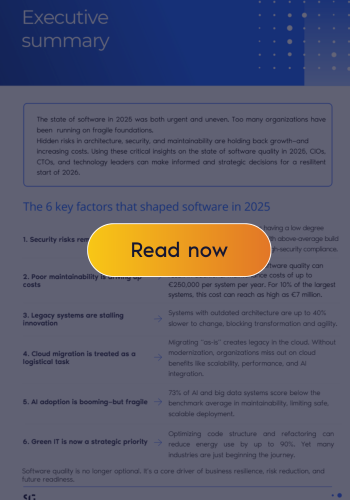
Step 1. Understand the 6 key factors that shaped software in 2025
We work with clients across all industries, and the story is consistent: software is powering entire organizations. But far too often, what’s under the hood isn’t ready for the journey ahead.
From the ongoing security risks to the mounting costs of the entire software landscape, quality gaps create real business impact.
Explore the six forces that defined 2025 and are now shaping every executive’s 2026 agenda →
What is on CIOs’ roadmap for 2026?
Based on industry research and discussions in professional communities, CIOs are aligning around a clear set of priorities:
- Scale AI with governance: Move from pilots to enterprise-wide AI platforms with guardrails, auditable models, and measurable value. Enterprise CEOs are pushing for AI governance (Forrester).
- Modernize core platforms: Reduce technical debt and shift toward cloud-native, API-first architectures that improve velocity and lower run costs.
- Strengthen cyber & resilience: Adopt zero-trust, harden hybrid environments, and embed operational resilience and sovereignty into core systems.
- Build unified data foundations: Consolidate data platforms to enable real-time decisioning, personalisation, and consistent customer/employee experiences.
- Redesign operating model & cost structure: Move toward product and platform teams, close AI/data/security skill gaps, and manage technology spend more strategically.
- Invest in quantum security: 5% of IT security budgets will be dedicated to quantum security enhancements (Forrester).
These themes form the backdrop for your transformation goals in 2026.
Step 2. Discover where you stand: define your IT maturity stage
We at Software Improvement Group has developed a four-stage maturity model based on 25+ years of analyzing software systems and guiding global technology leaders to increase innovation, lower costs, and move faster.
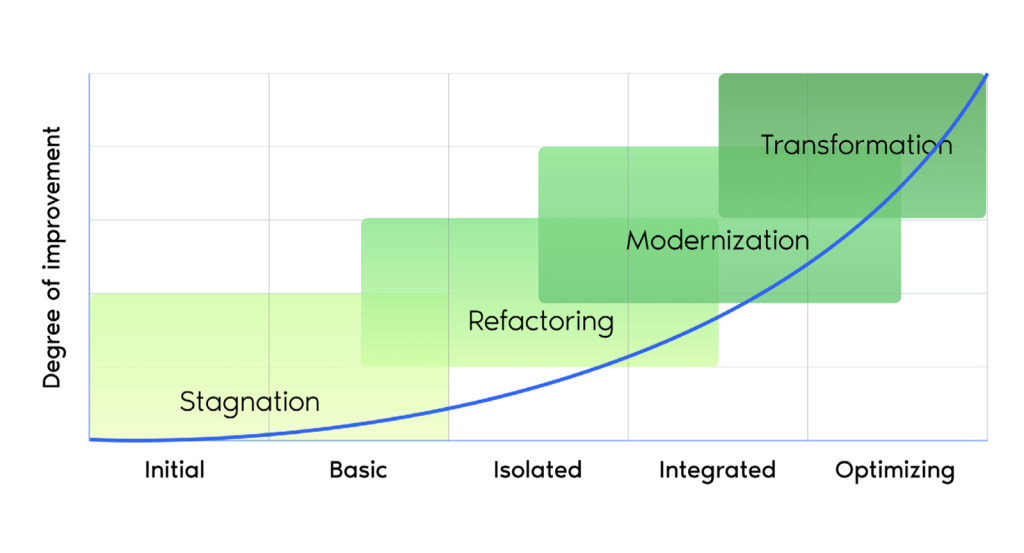
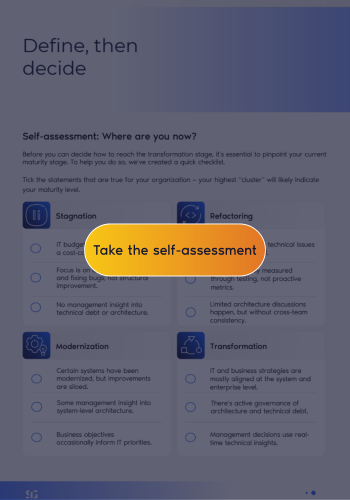
Stage 1: Stagnation
Operating with limited insight. Engineering decisions drive priorities, not business outcomes.
Stage 2: Refactoring
Firefighting is reduced, but improvements are still isolated and incremental.
Stage 3: Modernization
Teams can execute coordinated system-level change, but alignment with the business is not yet consistent.
Stage 4: Transformation
IT becomes a strategic partner that drives innovation. Few organizations are here — but every CTO should aim for it.
See the typical signals of each stage and the priorities leaders should focus on at each point →

Once you’re familiar with the four maturity stages, it’s time to determine where you stand →
Why this matters:
The stages form a sequence, not a menu. Each one builds the technical, cultural, and organizational capacity for the next. Moving too fast — especially with AI — amplifies unresolved weaknesses.
To pace change effectively:
- Anchor your strategy to your current stage. Invest in the improvements that will unlock the next level of maturity.
- Make progress visible. Track and communicate the improvements in quality, risk reduction, and delivery metrics so stakeholders back each step.
Step 3. Evaluate your AI readiness: learn the steps to AI governance
Your IT maturity stage directly influences how you should approach AI adoption.
The biggest challenge is no longer writing code; it’s about understanding it at scale and governing it across your systems.
So, let’s first address the elephant in the room: If your software maturity is low, should you hold off on AI coding adoption? That’s like asking a group of children not to touch the candy you left out on the table…it’s simply not going to work. Adoption is already happening: 90% of developers use AI tools in their workflow.
The key isn’t prohibition. It’s governance.
Success depends on intentional use, supported by visibility and oversight. AI can — and should — enhance productivity. But it must not come at the expense of quality, security, or compliance.
Discover 19 steps for board members, executives, and IT leaders to implement AI with confidence →
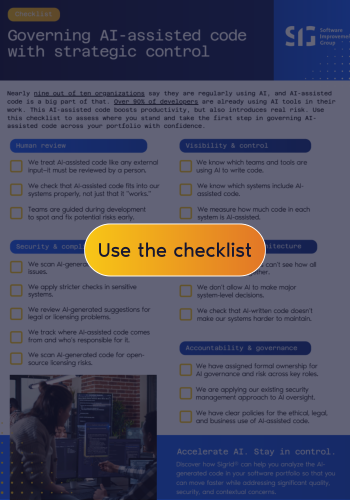
Evaluate how well you’re governing AI-assisted code across your portfolio →
Step 4. Get to planning: assess your IT portfolio
In finance, a CFO is expected to know exactly how much cash is available, the level ofdebt, and the liabilities on the balance sheet. Yet in IT, questions like
- How many applications do we have?
- How much has been invested in them?
- Who’s working on what, and what are they delivering?
…often get only approximate answers.
Most organizations operate with limited insight into the state of their software landscape.
Common characteristics include:
- Architecture is inherited and rarely questioned.
- Critical risks and inefficiencies remain hidden until they become costly problems.
- Digital transformation initiatives often launch without a grounded understanding of the foundations they depend on.
These gaps already carry significant risk. Today, the average system contains 19 security vulnerabilities, and poor build quality drives millions in annual maintenance costs. Generative AI amplifies both sides of this equation.
The final — and most critical — step is gaining a clear, factual view of your IT landscape.
See the insights we provide with a Software portfolio scan →