Meet Sigrid®

One platform to see & steer your complete software portfolio—in real time.

Trusted by 400+
leading enterprises

The only platform that takes care of the full picture.

Sigrid® gives you a holistic view of your entire software landscape, not just isolated parts.

"Sigrid is our one-stop shop for the most important metrics for our software portfolio."

400B+

Lines of code reviewed

30K+

Systems analyzed

300+

Technologies supported

Our features

01
AI Code Governance

AI Code Governance

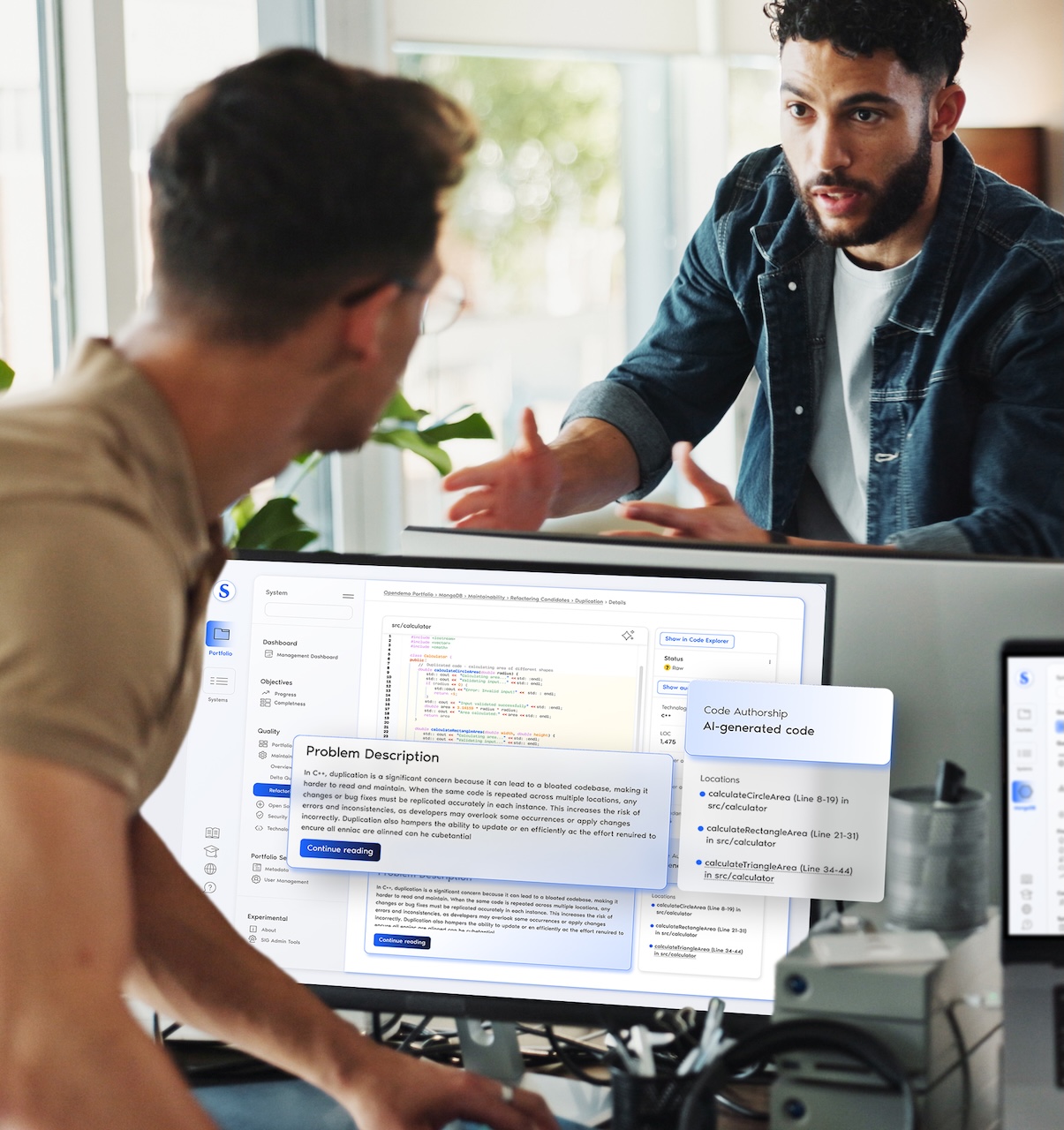
Detect AI-generated code and technologies across your portfolio, ensure it meets your quality and security standards, and avoid shadow adoption — so your teams can boost productivity without losing control.
Learn More
02
Management Dashboard

Management Dashboard

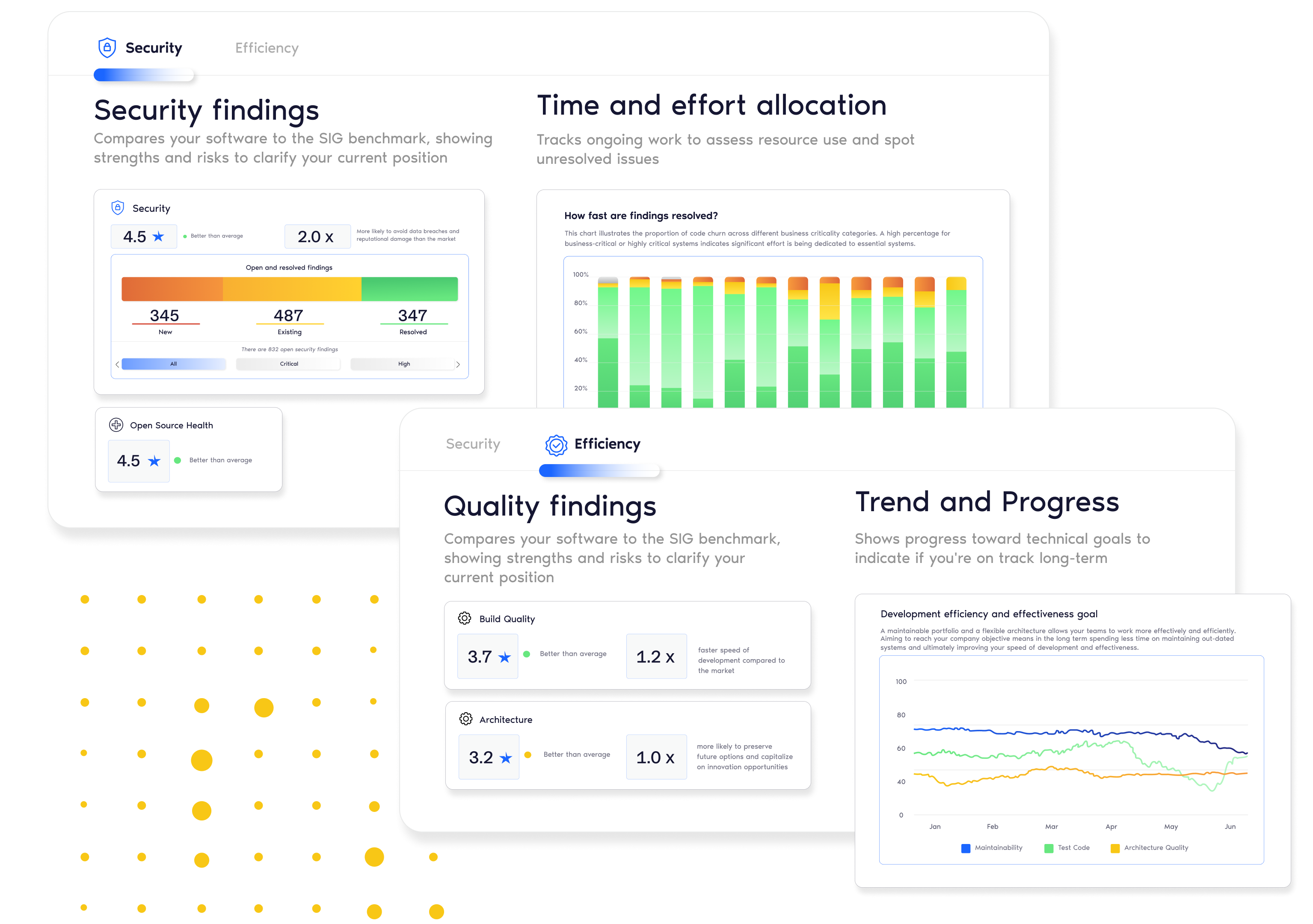
Translate technical findings into clear business KPIs so that you can simplify IT-business alignment.
Learn more
03
Portfolio Objectives

Portfolio Objectives

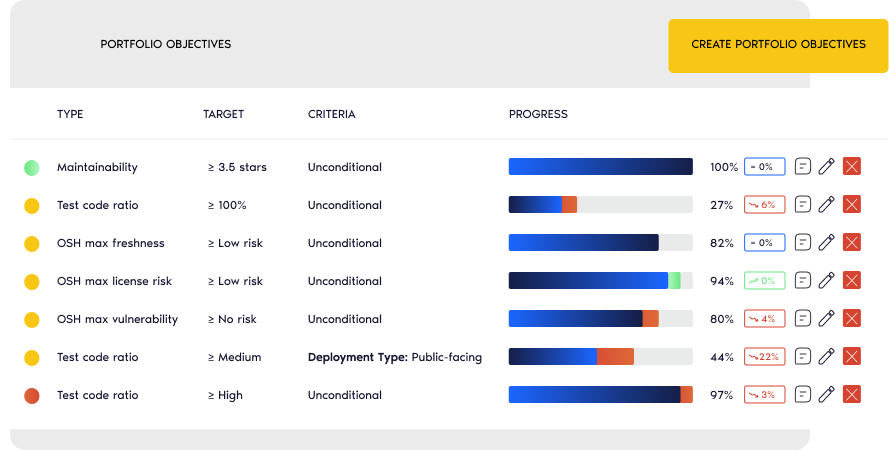
Set and track custom IT objectives that support your business strategy, helping you align IT investments with overall company goals.
Learn more
04
Security

Security

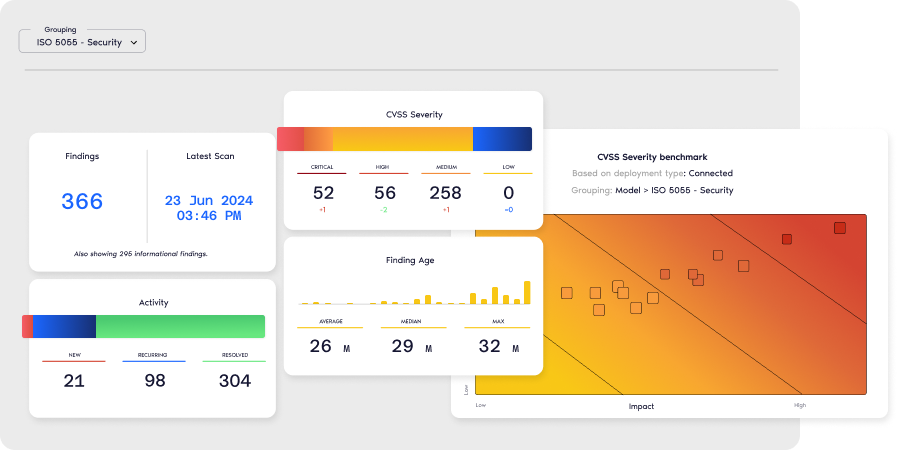
Continuously scan for vulnerabilities and prioritize fixes based on severity and business impact.
Learn more
05
Code Quality & Maintainability

Code Quality & Maintainability

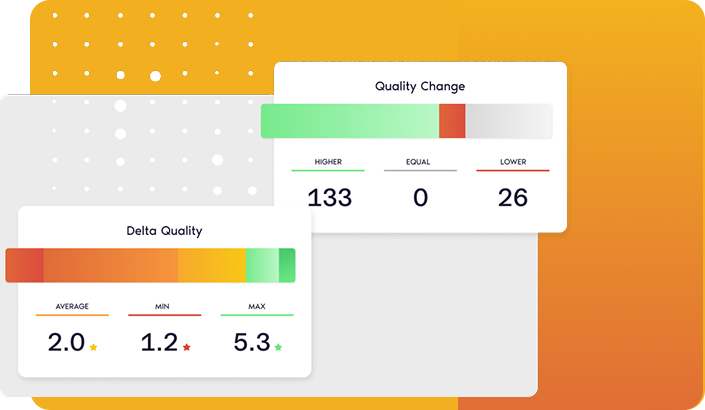
Identify technical debt and maintainability risks in your codebase to improve system stability and reduce long-term costs.
Learn more
06
Architecture Quality

Architecture Quality

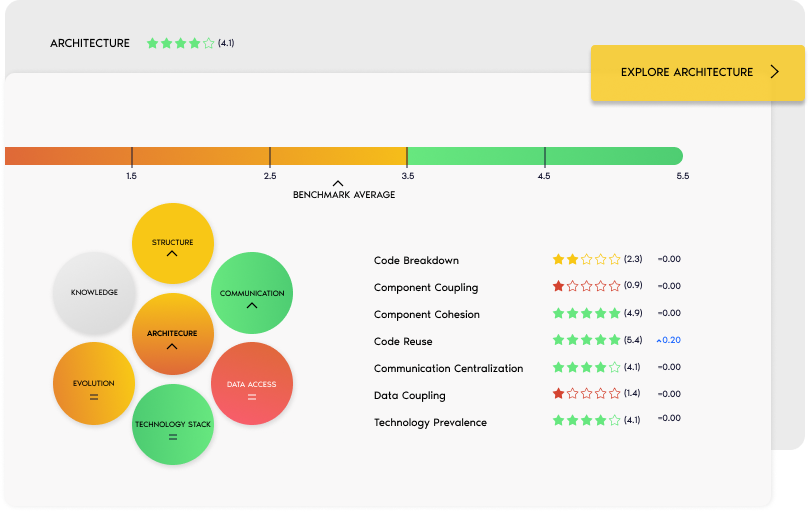
Gain visibility into your software architecture as-is. Access real-time diagrams to understand, optimize, improve your software systems. .
LEARN MORE
07
Open-Source Health

Open-Source Health

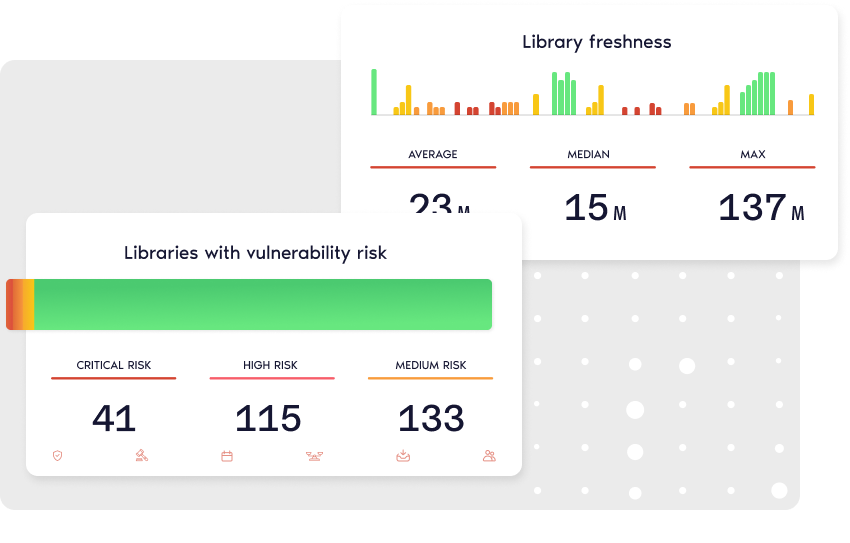
Monitor and manage open-source dependencies with a thorough software composition analysis (SCA). Spot vulnerabilities, license risks, and maintenance gaps to protect your software supply chain.
Learn more

How does it work?

Sigrid® brings clarity to complexity, combining deep code insights with expert guidance so that you can harness the full power of AI and govern the software your business runs on.

Go faster — responsibly.

01

Analyze your source code

Send your source code to Sigrid — our platform benchmarks it against the world’s largest software dataset.

02

Get your risk profile

Sigrid identifies weak spots and bottlenecks in your code, architecture, and third-party systems.

03

Act on expert advice

Prioritize fixes and align improvements with business goals.

04

Keep improving

Sigrid continuously monitors your software to flag risks early and ensure lasting performance.

  • “Tooling like Sigrid provides transparency, allowing us to manage our software proactively and maintain high standards. This is crucial for securely sharing personal data in our digital processes and staying ahead of potential security risks.”
    Kelly Bonneure

    Program Coordinator – MAGDA, Digitaal Vlaanderen
  • “With the help of Software Improvement Group, and their platform Sigrid, we can invest more effectively in code quality improvement and development."
    Petra Hendriksen

    Head of Mission Control at Alliander
  • Software Improvement Group helps us access and interpret the data so that we can improve things better and more quickly."

    Dieneke Schouten,

    Operational Director - Public Sector Solutions at Centric
  • “We chose Sigrid to validate the strength of our code base, ensuring our foundations are as robust as we believe. This allowed us to focus our investments on targeted improvements and bolster our security, turning insight into action for a safer, stronger product.”

    Gijs Zijderveld,

    Head of Technology at Intergamma.
  • “We needed an independent partner to help us measure the systems. They can tell us that everything is perfectly fine, but we needed to know for sure. With Sigrid®, we’re getting more guarantees that the software that’s being delivered is up to par.”

    Joel Sanches,

    Board Member, SBIR

Go faster.
Stay in control.

Frequently asked questions

What is continuous software portfolio governance?

Continuous software portfolio governance is the ongoing practice of tracking and steering the quality, risks, and evolution of software across the entire portfolio. It gives leaders a current view of the landscape, not a periodic snapshot.

Can't we just use AI to review the code AI generates?

LLMs, AI coding assistants, and agents can generate and even help review code—but they’re fundamentally limited.

They rely on associative, pattern-based reasoning, which makes them fast but not always accurate. They can miss critical flaws because they don’t have full system context or understanding of your architecture. That’s why you need deterministic analysis tools and expert reviews to properly govern AI-generated code.

AI coding assistants and agentic AI holds great promise for accelerating software development and modernizing legacy systems. However, they also introduce significant challenges related to code quality, security, architecture, and even legal issues.

Enterprises scaling AI need comprehensive solutions to manage these risks effectively.

Why should I trust Sigrid® findings?

Sigrid® findings are based on standardized, repeatable measurements of source code, not one-off opinions. Software Improvement Group measures software against globally recognized standards, including ISO/IEC 25010 for software quality, ISO/IEC 5055 for code quality, and ISO/IEC 27001 for information security management.

That approach is backed by independent accreditation. We are the world’s first and only laboratory accredited under ISO/IEC 17025 for software quality analysis, certified by TÜViT. 

For a deeper look at the standards and methodology behind these findings and our models, see our more detailed page on the topic.

Why do you need continuous software portfolio governance?

Software does not stand still. Systems change, dependencies shift, and risks build up over time. A continuous approach helps organizations spot issues before they become problems and help make better decisions.

What technologies and programming languages does Sigrid® support?

Sigrid® is technology-agnostic and currently has supported over 300 different technologies. Naturally, we support popular languages such as Java, C#, and Python. We also support some more specialized but still widely-used technologies like COBOL, PL/SQL, and Docker.

On average, we were adding about 20 new technologies per year. If there's a specific technology you're curious about, we'd be more than happy to check on our current support level. We're always expanding our capabilities, so even if we don't fully support something today, there's a good chance we could add or improve support if needed for your project.

How do you define the quality of software and set a benchmark?

Generally, to assess the quality of something, you need a sense of context. Each piece of software may have a widely different context. To put objective thresholds on code quality, at SIG we use technology-independent code measurements and compare those to a benchmark.

A benchmark on quality is meaningful because it provides an unbiased norm of how well you are doing.

The context for this benchmark is “the current state of the software development market”.

This means that you can compare your source code to the code that others are maintaining.

To compare different programming technologies with each other, the metrics represent a type of abstractions that occur universally, like the volume of pieces of code and the complexity of decision paths within. In this way, system size can be normalized to “person-months” or “person-years”, which indicate of amount of developer work done per time period. Those numbers are again based on benchmarks.

Summarizing, Sigrid compares analysis results for your system against a benchmark of 30,000+ industry systems. This benchmark set is selected and calibrated (rebalanced) yearly to keep up with the current state of software development. “Balanced” here can be understood as a representative spread of the “system population”. This includes anything in between old and new technologies, from anything legacy to modern JavaScript frameworks. In terms of technologies this is skewed towards programming languages that are now most common, because that best represents this current state. The metrics underlying the benchmark approach a normal distribution. This offers a sanity check of being a fair representation and allows statistical inferences on “the population” of software systems.

How does the 5-star system work?

The code quality score compared to the benchmark is expressed in a star rating on a scale from 1 to 5 stars. It follows a 5%-30%-30%-30%-5% distribution.

Technically, its metrics range from 0.5 to 5.5 stars.

This is a matter of convention, but it also avoids a “0” rating score because 0 is not a meaningful end on a quality scale. The middle 30% exists between 2.5 and 3.5, with all scores within this range rated as 3 stars, representing the market average.

Even though 50% of systems necessarily score below average (3.0), 35% of systems will score below the 3-star threshold (below 2.5), and 35% will score above the 3-star threshold (above 3.5). To avoid a suggestion of extreme precision, it is helpful to think about these stars as ranges, such that 3.4 star would be considered “within the expected range of market average, on the higher end”. Note that calculation rounding tolerances are always downwards, with a maximum of 2 decimals of precision. So, a score of 1.49 stars will be rounded down to 1 star.

How does Sigrid® integrate with our existing CI/CD pipeline?

Sigrid CI can be used to publish main branch code to Sigrid for baseline analysis, and to get feedback on pull requests. 

Integrating Sigrid into your development environment serves two purposes. First, it will publish your systems to Sigrid after every change, ensuring Sigrid is always-up-to-date and removing the need for manual uploads. Second, it allows you to provide your development teams with direct feedback after each change. Sigrid supports integrations with 10+ different development environments, such as GitHub or BitBucket.

What information does Sigrid® use for the change history analysis?

Sigrid uses your anonymized repository history to calculate metrics on which code has been changed, and when those changes were made. These statistics do not contain personal information. In fact, if you use Sigrid CI, the developer names will be anonymized client-side, so before anything is published to Sigrid.
You can find more information on Sigrid data usage in our Privacy Statement.

Experience Sigrid live

Request your demo of the Sigrid® | Software Assurance Platform:
  • This field is for validation purposes and should be left unchanged.

Register for access to Summer Sessions

This field is for validation purposes and should be left unchanged.
Name*
Privacy*