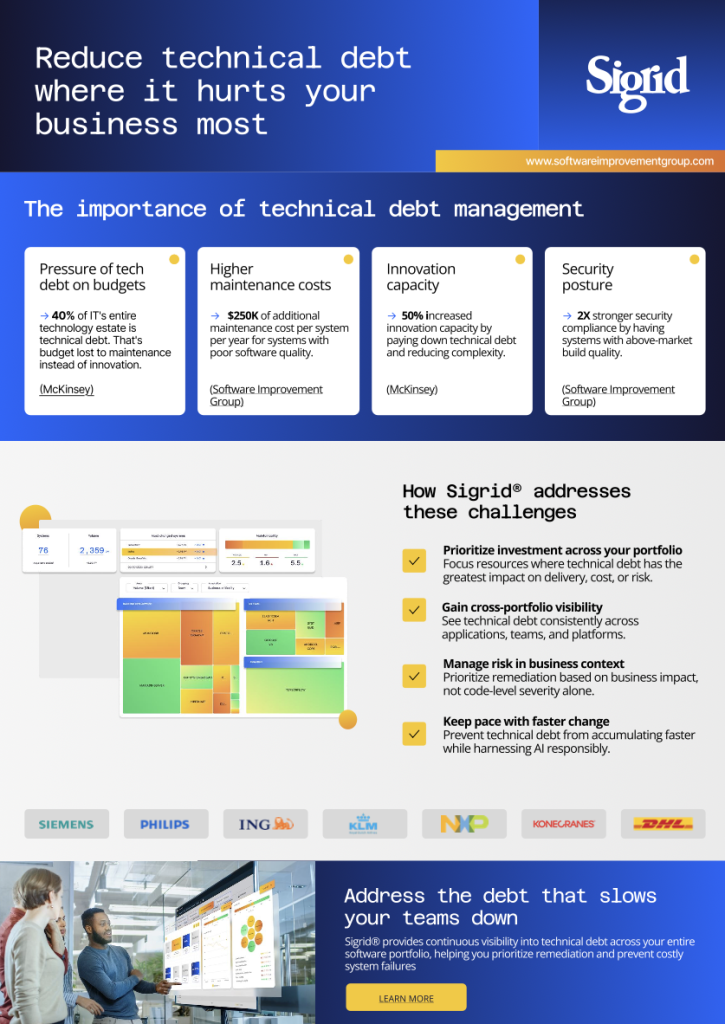
Prioritize improvements with business context and move faster—responsibly.
Technical debt is the extra effort teams incur over time because of earlier shortcuts or suboptimal implementation choices. What starts as a local trade-off can turn into a broader delivery, cost, and risk problem when it is not governed continuously across the portfolio.
As code and architecture become harder to understand and change, maintenance takes more time and effort. Teams spend more of their budget keeping existing systems stable and less on meaningful improvement. Over time, issues that could have been addressed earlier become more expensive to fix.
Technical debt reduces the time engineers can spend on new work. Instead of building, improving, or modernizing, teams are pulled into recurring fixes, workarounds, and avoidable maintenance. That lowers capacity and makes it harder to sustain momentum across the portfolio.
AI-assisted development helps teams produce software changes faster, but faster change does not reduce technical debt by itself. Without clear visibility, shared standards, and continuous governance, technical debt can even accumulate faster and become harder to contain across the portfolio.
Technical debt often starts with pressure to deliver quickly, but over time it has the opposite effect. As maintenance effort increases and complexity builds up, teams have less room to deliver new features and products on time. Roadmaps become harder to execute and change becomes slower to ship.
Technical debt increases development cost, delay return on investment, and raise operational or security risk. Without a portfolio-wide view, these costs are easy to underestimate and hard to prioritize.
Architectural technical debt is the accumulated cost of structural compromises in how your software systems are designed and connected. Unlike code-level debt (messy functions, duplicate code), architectural debt affects how entire systems interact, how components depend on each other, and how your portfolio scales.
Resolve high-impact issues for maximum ROI
Focus resources where technical debt has the greatest impact on delivery, cost, or risk.
Spot where technical debt hurts you the most
See technical debt consistently across applications, teams, and platforms. Establish a baseline, and track trends.
prioritize based on business impact
Prioritize remediation based on business impact, not code-level severity alone.
Stay in control as systems evolve
Avoid technical debt from accumulating faster while harnessing the power of AI.
Know where you stand and where to improve
Assess critical software systems
Technical debt resources
Technical debt is the extra effort teams spend maintaining and changing software because earlier implementation choices were suboptimal. Like financial debt, shortcuts can save time in the moment, but they create “interest” later through higher maintenance effort, slower delivery, and more risk.
AI coding tools make software change faster and mistakes harder to contain. That increases the need for visibility, shared standards, and continuous governance so organizations can move faster without losing control of quality, security, or spend.
No, technical debt is not always a bad thing. Sometimes, it’s a necessary trade-off to move fast. Just like financial debt is not always bad, sometimes it’s necessary to achieve a goal.
It depends on intent and management. For example, prudent, deliberate debt aligned with a clear payback plan can be good. Reckless or ignored debt accumulates interest and becomes bad, harming velocity, quality and security.
LLMs can generate and even help review code—but they’re fundamentally limited. They rely on associative, pattern-based reasoning, which makes them fast but not always accurate. They can miss critical flaws because they don’t have full system context or understanding of your architecture. That’s why you need deterministic analysis tools and expert reviews to properly govern AI-generated code.
AI coding assistants hold great promise for accelerating software development and modernizing legacy systems. However, they also introduce significant challenges related to code quality, security, legal issues, and efficiency. Enterprises adopting these tools need comprehensive solutions to manage these risks effectively.
In large organizations, technical debt shows up across dozens or hundreds of systems that depend on each other and compete for the same budget. That makes it a governance issue, not just a team backlog issue.
Team backlogs do not create a portfolio view. Leaders still need shared metrics, clear ownership, and a consistent way to compare applications, teams, and platforms so they can decide where technical debt matters most.
Not all technical debt is equally urgent. Prioritization should reflect business impact, including revenue exposure, regulatory commitments, resilience, product plans, and delivery risk.
Technical debt changes with every code change, release, and architectural decision. Point-in-time inventories go stale quickly, so organizations need ongoing measurement and trend analysis to detect growth, measure remediation impact, and keep plans current.
Technical debt can increase maintenance effort, reduce delivery capacity, slow time to market, and raise operational or security risk. It also makes it harder for business and IT leaders to align on where to invest first.
Architectural technical debt is the accumulated cost of structural compromises in how your software systems are designed and connected. Unlike code-level debt (messy functions, duplicate code), architectural debt affects how entire systems interact, how components depend on each other, and how your portfolio scales.
Architectural debt includes tightly coupled modules, dependency sprawl, erosion of intended design patterns, and structural risks that span multiple systems.
Code-level debt lives inside individual files and functions. Architectural debt lives between systems and across your entire software portfolio.
Code-level debt: duplicate code, long methods, poor naming, missing tests
Architectural debt: tightly coupled services, hidden dependencies, fragile integration points, structural drift from intended design
Code-level debt slows down individual developers. Architectural debt creates breaking points that destabilize entire portfolios.

AI coding tools are accelerating code creation while introducing new forms of architectural risk. While AI assistants can fix code-level issues like duplication or formatting, they often miss systemic problems like dependency sprawl, coupling between services, and architectural drift.
When developers use AI to generate code without architectural context, they create hidden dependencies and integration points that compound over time. The faster you ship code, the faster architectural debt accumulates without continuous visibility.
If you have questions that aren’t covered here, feel free to reach out. We’re always happy to help you with more information or clarifications.