We analyzed the code of ArtCraft’s AI-built Adobe clones
In this article
In October 2026, Brandon Thomas of ArtCraft released seven free AI Adobe clones, built with Claude Opus 5.5 in about ten days.
We ran all seven through Sigrid® Core, the software portfolio governance platform of Software Improvement Group (SIG), to measure their AI code quality against our benchmark and quality standards.
Our analysis found reasonable security scores but low maintainability and architecture scores, which make fixes and updates slower and riskier.
Our analysis shows:
- The ArtCraft suite adds up to roughly 154 person-years of code, more than 1.2 million lines of code.
- None of the seven apps reaches 2 stars for maintainability. Scores range from 1.6 to 1.9, against a market average of 3.
- Architecture ranges from 1.9 to 2.5, against a market average of 3.
- PhotoCraft, the Photoshop clone, scores 0.7 on modularity. Its weakest point is how its parts connect, and that makes every future change harder for humans and AI agents alike.
- Security score looks reasonable.
Background of ArtCraft: A cancellation fee and seven apps
Brandon Thomas wanted to cancel his Adobe subscription. Adobe wanted a cancellation fee.
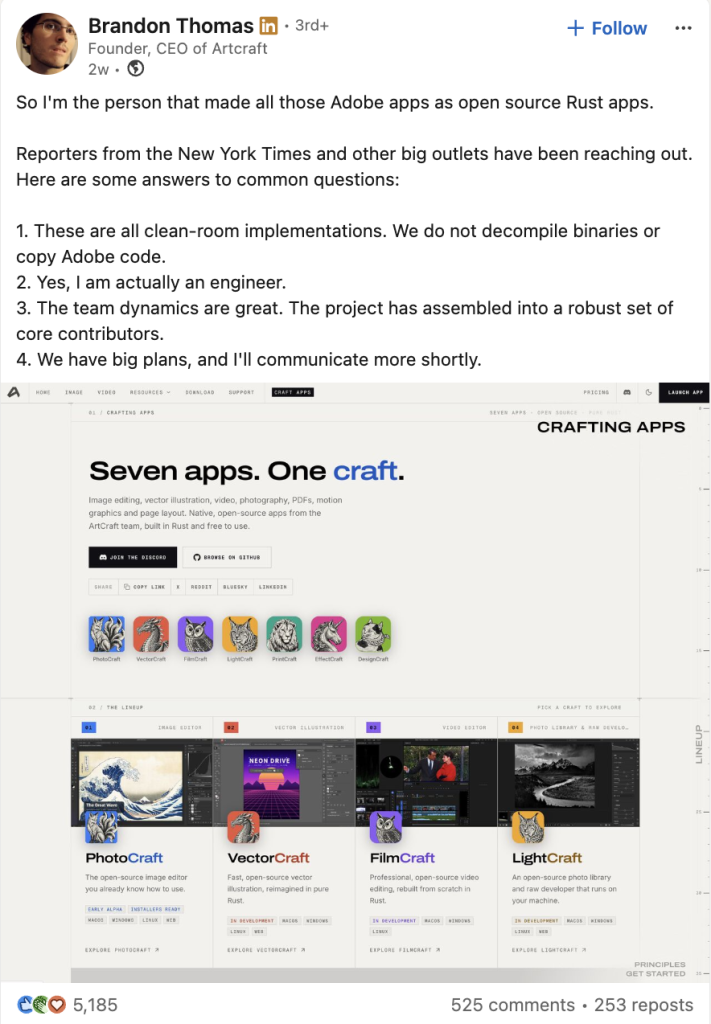
Photoshop, Illustrator, Premiere, Lightroom, After Effects, InDesign, and Acrobat.
According to the timeline that Rough Cut Pete pieced together from the public code history, the first code landed on 30 September. A week later, the suite was on Reddit and Hacker News, and PhotoCraft alone collected thousands of GitHub stars within days.
Thomas then boldly told Hacker News that “software is over.” Let’s see if his words have any merit and let’s start with giving him some well-deserved credit. I mean, calling creating a clone of the full Adobe suite in 10 days impressive is kind of an understatement.
Why is this so impressive?
A small team shipped a working seven-app suite in about ten days, at a scale that would normally take years.
Brandon Thomas is not a marketing designer who got frustrated with his Photoshop licence, watched a few YouTube videos, and decided to vibecode himself an alternative just because he had AI.
Far from it.
Brandon Thomas describes himself as a 15-year industry veteran who has used Rust for about a decade. The apps run on Mac, Windows, Linux, and FreeBSD, and even in a browser.
They’re open source under the Apache-2.0 and MIT licenses, and built clean-room, from public specifications and observed behavior, with no Adobe code.
Reviewers found the interfaces so close to Adobe’s that switching between them takes no relearning. The PhotoCraft README even describes a deliberate architecture, with layering enforced at build time across 24 crates.
And the scale is massive.
By our estimate, PhotoCraft alone holds 30 person-years of code. At average market productivity, that’s 30 developers working a full year. While that calculation method comes from a pre-AI era, it still gives a pretty good idea of how large these systems are.
The full ArtCraft suite adds up to roughly 154 person-years and has more than 1.2 million lines of code.
Is the ArtCraft Adobe clone good?
It depends on how you look at it. What everybody usually looks at first is the functionality of the apps themselves.
And while the reactions were overall positive and in awe of what was done, the functionality seems to be far from a 10/10 experience.
Reactions ranged from “software is over” to comedy sketches calling the vibe-coded Photoshop spaghetti.
Creative Bloq said it’s “impressive how much it can do considering that it was made and tested using AI and weighs next to nothing, but it’s not currently stable or complete enough to be able to replace existing software”.
Vice called the suite glitchy and early alpha.
Brandon Thomas himself admits there’s a long way to go before the clones match Adobe on features and file formats. But the project isn’t done. On Reddit, he wrote:
“We are absolutely going to bring these to full parity and squash every bug and feature request.”
So we decided to see what the non-functional quality of the software is, and specifically look at how easy it would be to maintain, improve, and build upon this AI-generated codebase.
Here’s what we found.
How we measured AI code quality in ArtCraft
We ran the analysis on 12 October 2026, so we were looking at code roughly two weeks old. Since then, the code has already changed a lot since. While we write this, PhotoCraft alone now has more than 6,500 commits, so it’s important to know that these scores describe the October 12th version.
We used Sigrid Core and the same quality models we apply across our benchmark of more than 40,000 real-world systems and 600 billion lines of code, spanning more than 300 technologies.
Our quality models are rooted in international standards, refined for 25+ years in the world’s only ISO/IEC 17025-accredited software quality lab.
How does the star rating work?
You can read more about our approach here, but in short: On our scale, 3 stars is the market average and 4 stars is our recommended target for new systems. Scores run from 0.5 to 5.5.
A star rating means something because tens of thousands of real systems sit behind it, so it tells you where code stands against the market.
That said, falling short of 4 stars is pretty common.
In our State of Software 2026, we found that 86% of code falls below our recommended maintainability rating, 50% scores below our recommended architecture rating, and 71% has a low degree of security controls.
So how do the ArtCraft Adobe clones hold up? We measured maintainability, architecture, and security.
In non-technical terms, when we analyzed these code repositories, we asked three simple questions:
- Maintainability: How easy will it be to make changes to this system over time?
- Architecture: How well can you understand the structure and interconnections within the system?
- Security: How well have security considerations been factored into the design and implementation?
Code quality of ArtCraft AI-built Adobe clones
We analyzed all seven apps, and the results are similar across the ArtCraft suite.
| Artcraft app | Maintainability score | Architecture score | Security score |
|---|---|---|---|
|
PhotoCraft
(Photoshop clone) |
1.6/5 |
1.9/5 |
3.8/5 |
|
FilmCraft
(Premiere clone) |
1.9/5 |
2.3/5 |
3.3/5 |
|
EffectCraft
(After Effects clone) |
1.7/5 |
2/5 |
3.8/5 |
|
VectorCraft
(Illustrator clone) |
1.8/5 |
1.9/5 |
3.7/5 |
|
LightCraft
(Lightroom clone) |
1.7/5 |
1.9/5 |
5/5 |
|
PDFCraft
(Acrobat clone) |
1.7/5 |
2.2/5 |
3.2/5 |
|
DesignCraft
(Indesign clone) |
1.7/5 |
2.5/5 |
5/5 |
PhotoCraft quality deep dive
To go a bit deeper into these findings without making the article way too long, we picked PhotoCraft. It’s the most popular app in the suite, and it’s one of the largest in the suite.
How maintainable is PhotoCraft?
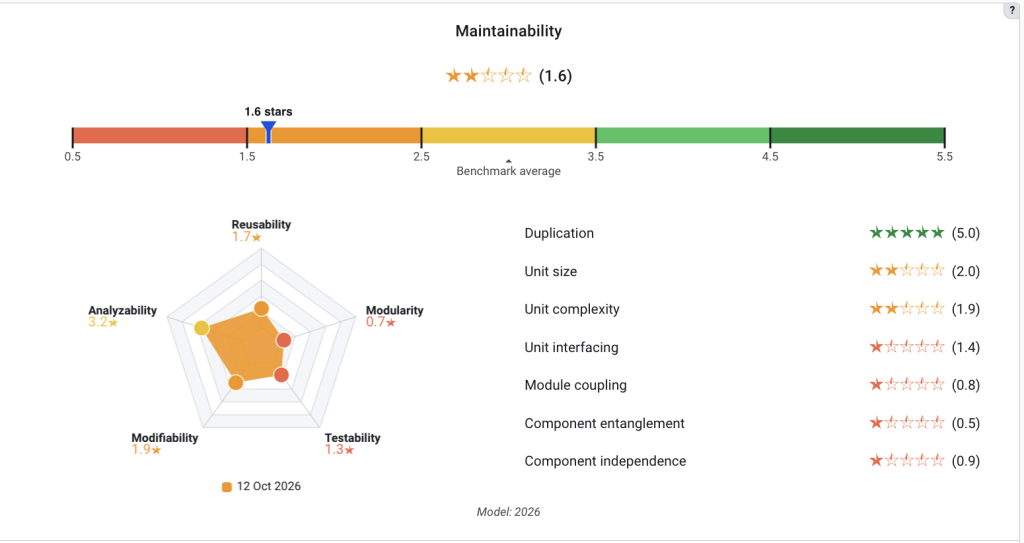
1.6 stars out of 5, meaning it’s part of the worst 30% of code in our entire benchmark.
Maintainability is how easily code can be understood, changed, and tested. At Software Improvement Group, we run the world’s first and only TÜViT-certified software quality lab, and measure maintainability using a model based on ISO/IEC 25010.
PhotoCraft was created recently, and it started there. You could argue it was born as legacy, riddled with technical debt.
This reminded me of a SIGNAL podcast episode where my colleague Werner Heijstek discussed the AI-built Fastrender webbrowser example with our CEO Luc Brandts, earlier this year. The findings of that fully agentically-built system were quite similar, and Werner concluded:
“So it’s an impressively productive way of creating a legacy system and that’s exactly what happened.”– Werner Heijstek, SIGNAL Podcast episode, April 2026.
Let’s take a look at the individual scores that make up the 1.6/5 maintainability score.
Inside individual functions, PhotoCraft is weak but not the worst. Unit size scores 2.0 and unit complexity 1.9.
Between the parts of the system, it falls apart. Component entanglement scores 0.5, module coupling 0.8, and component independence 0.9. Together they give PhotoCraft a modularity score of 0.7, the lowest of anything we measured.
The connections between components are where nobody looks. A reviewer skimming the repo sees reasonable-looking functions.
So when is this a problem?
In a nutshell: the trouble will show up when you change one part and something elsewhere breaks.
Two scores that look too good
Duplication scores 5.0, a perfect-looking result.
Our duplication metric detects exact copies. My colleague who did the analysis pointed out that AI-written code may contain near-copies, the same logic with renamed variables, which an exact-match check won’t catch.
It could be that the high duplication score is not the bright spot it seems. We’re now looking at whether to normalize code, for example, variable names, before checking for duplicates.
How sound is PhotoCraft’s architecture?
1.9 stars, against a benchmark average of 3. Similar to the maintainability score, this means its part of the worst 30% in our entire benchmark.
Our Architecture Quality model measures modularity at a higher level: how well a system is divided into components, and how independently those components can be changed.
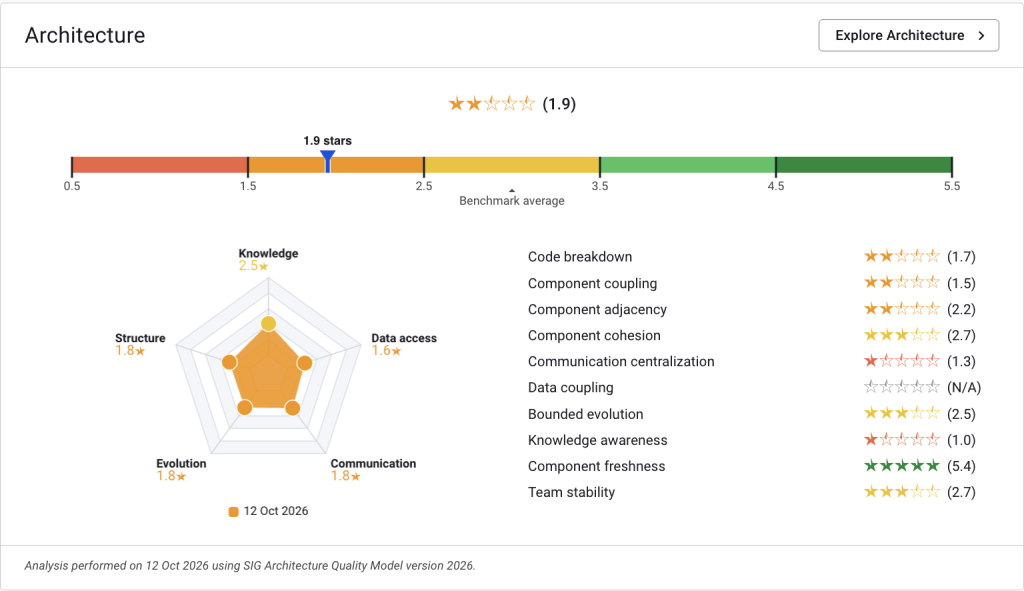
Let’s take a look at the individual scores that make up the 1.9/5 architecture score.
Structure scores 1.8.
Communication centralization, which measures how much of a component’s code is shielded from the rest of the system, scores 1.3. Component coupling scores 1.5.
So, what does that mean in layman’s terms?
The parts of PhotoCraft depend on each other too much, and in too many places.
In the image below, you can see the “spaghetti-code” architecture diagram of the system.
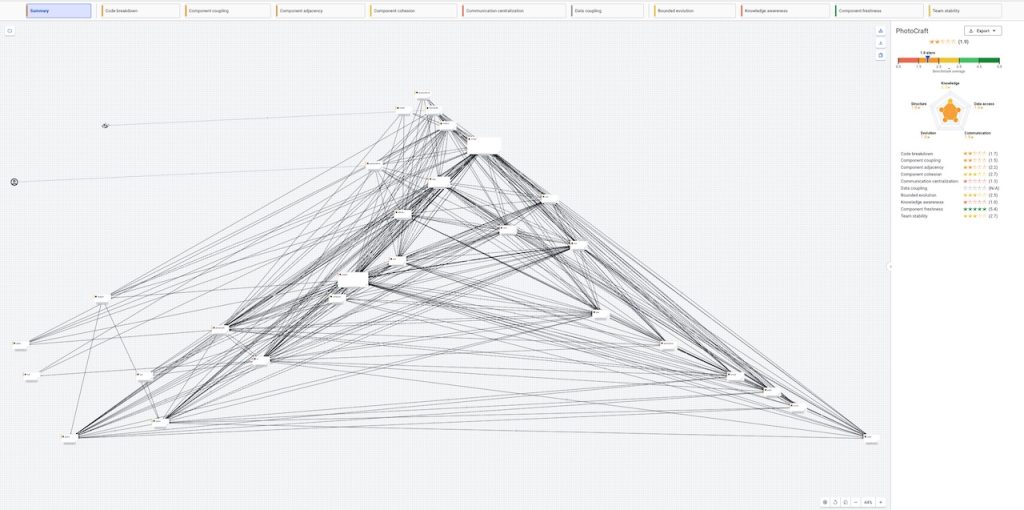
Two metrics need context.
Knowledge awareness scores 1.0: very few people hold the knowledge relative to the size of the code, which is expected for a project led by one person.
Component freshness scores 5.4, because a two-week-old project changes constantly.
Both rest on very little history, so we’ll need to revisit them in a while to see if there will be changes.
Is PhotoCraft’s code secure?
PhotoCraft scores 3.8, above the market average, and the suite ranges from 3.2 to 5.5. Rust deserves some credit here, since its memory safety rules out a whole class of vulnerabilities by design.
For comparison, our State of Software 2026 found that 71% of code has a low degree of security controls.
Two caveats.
A good score means our analysis found relatively few issues, and it stops short of certifying the apps for professional work. These are tools people will use to open files from other people, which is a classic attack surface. Also, for editorial and length reasons, this article didn’t take the open source element into consideration, but I can say that five of the seven apps showed acute risk in one or two open source libraries.
Is ArtCraft safe to use instead of Adobe?
Well, not really. You need to be aware that you’re installing vibe coded software to your machine that has access to your personal information, data, and passwords.
Can you really trust it? I personally wouldn’t.
If you’re planning to use it professionally for client work or files you can’t afford to lose, I’d suggest to be even more careful.
ArtCraft agrees.
Its own README states that PhotoCraft is “not yet a Photoshop replacement for daily professional work.”
Also, good to understand that our analysis covers code quality, architecture and security, and doesn’t cover malware or download safety.
We can’t compare PhotoCraft to Photoshop’s code, because Adobe’s source isn’t public. So we make no claim about Adobe’s code.
Generally speaking, what a paid tool gives you is an organization committed to maintaining, testing, and supporting it.
And that’s where these scores cause concern.
Here’s how those low scores affect maintaining, testing, and supporting it
A software system is never done; new features are added and improvements are happening constantly. So, how do our ratings translate to doing that to this system?
- Slower fixes and features
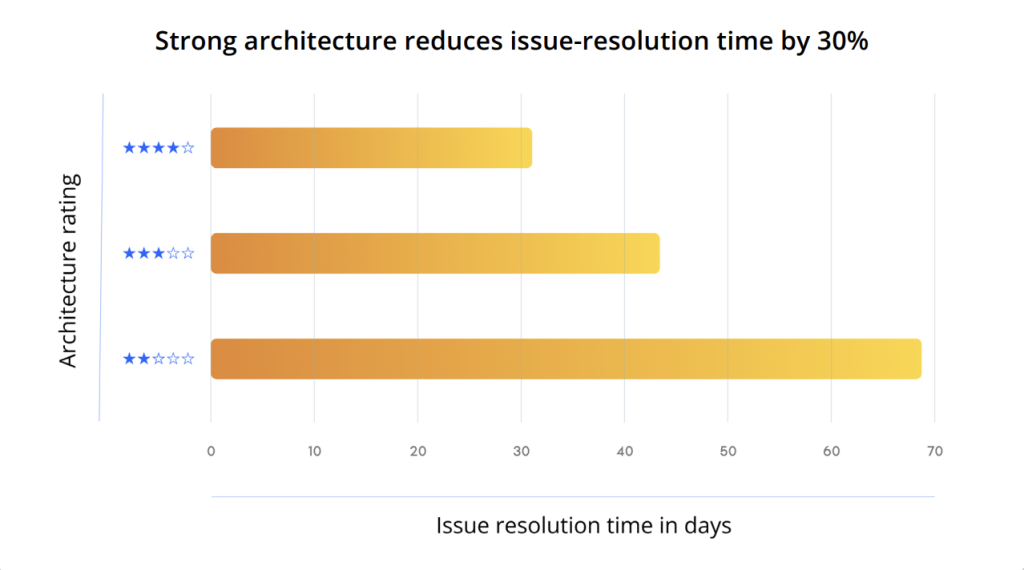
Low maintainability and architecture make every change take longer. Thomas first promised feature parity with Adobe within a month and has since moved that to months. With this structure, the road there runs uphill. Our State of Software 2026 found that a stronger architecture cuts issue-resolution time by 30%. - Updates that break other things
With components this entangled, a fix in one place can cause problems somewhere else. That’s a real risk if you rely on the tool for client work. - More bugs reaching you
PhotoCraft has more than 1,700 tests, which is nice. But testability, which measures how easy the structure makes testing, scores 1.3. Tangled code is harder to test thoroughly, however many tests you write, so problems are more likely to slip through to a release. - Slower security patches
When a vulnerable library needs replacing, tangled code makes the change slower and riskier. - Your files
Professionals need to be able to trust these tools with client work and years of archives, and regressions in file handling are the expensive kind. At the very least, you should keep backups. - Longevity
Thomas has a small team. They have to understand code they didn’t write (AI mostly did) before they can change it safely, and low modularity makes that slow.
Can’t AI just fix all of this?
Now, I hear what you’re thinking: A better prompt and simply regenerating these systems will fix it.
You can try, but even the latest AI models still have a limited context window, tend to hallucinate, and make confident mistakes while trying to please you. Not even mentioning the cost for generating code for systems this large are far from cheap.
Ironically, AI coding agents work a lot more efficiently in a clean codebase.
That’s right, when code is well structured, an agent has to read less of it to find what it needs, so every change costs fewer tokens.
A refactoring experiment published on Martin Fowler’s site showed this on an agent-built Rust app: after one oversized file was refactored, the same change cost 83% fewer input tokens.
PhotoCraft’s communication centralization of 1.3 describes the opposite situation. Dependencies are spread across the code, so any agent changing one part has to read far more of the system to avoid breaking something.
Humans used to pay for bad structure in slower delivery and increased maintenance. Now they pay in tokens, because agents have to wade through code that could have been much easier to navigate.
I’m not saying don’t use AI, far from it. You just need to enhance it.
What would have caught this earlier?
A check on every agent change, while the code is being written, would be ideal.
Everything in this article came from Sigrid Core. It sets the standards, governs the whole portfolio, and enforces those standards in the CI pipeline. That’s the view you need to decide what to trust and what to fix.
In PhotoCraft’s case, though, the problems were built in as the code was written.
The place to catch them is inside the agentic loop that writes the code.
That’s why we built Sigrid® Axis. It applies the same standards while the agent works.
Its Guardrails check every agent change against the architecture of the specific system it’s working in, plus your maintainability and security standards, and fix violations before they’re committed.
The checks are deterministic and grounded in the world’s largest software quality benchmark, so you’re not relying on a second AI to check the first.
Applied to a codebase like PhotoCraft, Sigrid Axis’ Guardrails would have flagged the growing entanglement change by change, before it compounded.
So, if you want to build software with AI coding agents and be able trust the code that’s generated, feel free to reach out.
About the author

Jasper Geurts
Jasper Geurts helps organizations adapt to the agentic software
development lifecycle, so they can trust the code their agents write. As CTO at Software Improvement Group, he leads the technology behind Sigrid® Axis, the platform that works with AI coding agents to produce secure, maintainable code that respects the architecture it lives in.
Equip your AI coding agents with the right context
Frequently asked questions
Is ArtCraft made with AI?
Yes. Developer Brandon Thomas built the apps with Anthropic’s Claude Opus 5.5.
Is ArtCraft safe to use?
We can’t guarantee that. Our analysis found reasonable security scores but low maintainability and architecture scores, which make fixes and updates slower and riskier. But there is a lot more to it. You could be installing potential malware on your computer and giving it access to personal information, data, or passwords.
What is vibe coding technical debt?
It’s the future cost of change that builds up when AI writes code faster than anyone checks its structure. It shows up as slower fixes, unexpected breakage, and, for AI agents, more tokens spent on every change.
Does AI reduce architectural debt?
Not by default. AI can help fix code-level debt such as duplication and complexity. Architectural debt needs whole-system context that AI tools generally lack, so agents working without that context tend to add to it.
AI agents optimize for the task in front of them, and a fix that works locally can break something system-wide.
However, Sigrid® Axis works with AI coding agents to produce secure, maintainable code that respects the architecture it lives in. Each check runs against the architecture of the individual system, repository, or component the agent is working in, not just an organization-wide set of rules.
Learn more about Sigrid Axis.