The first-ever Magic Quadrant™ in this category.
As AI tools generate code faster than teams can review it, architectural debt accumulates in the gaps. Architectural debt is the blind spot. Portfolio-wide governance is the answer.
Get your complimentary copy of the Gartner® Magic Quadrant™ for Technical Debt Management Tools.
SIG privacy policy applies. We’ll send the report link immediately.
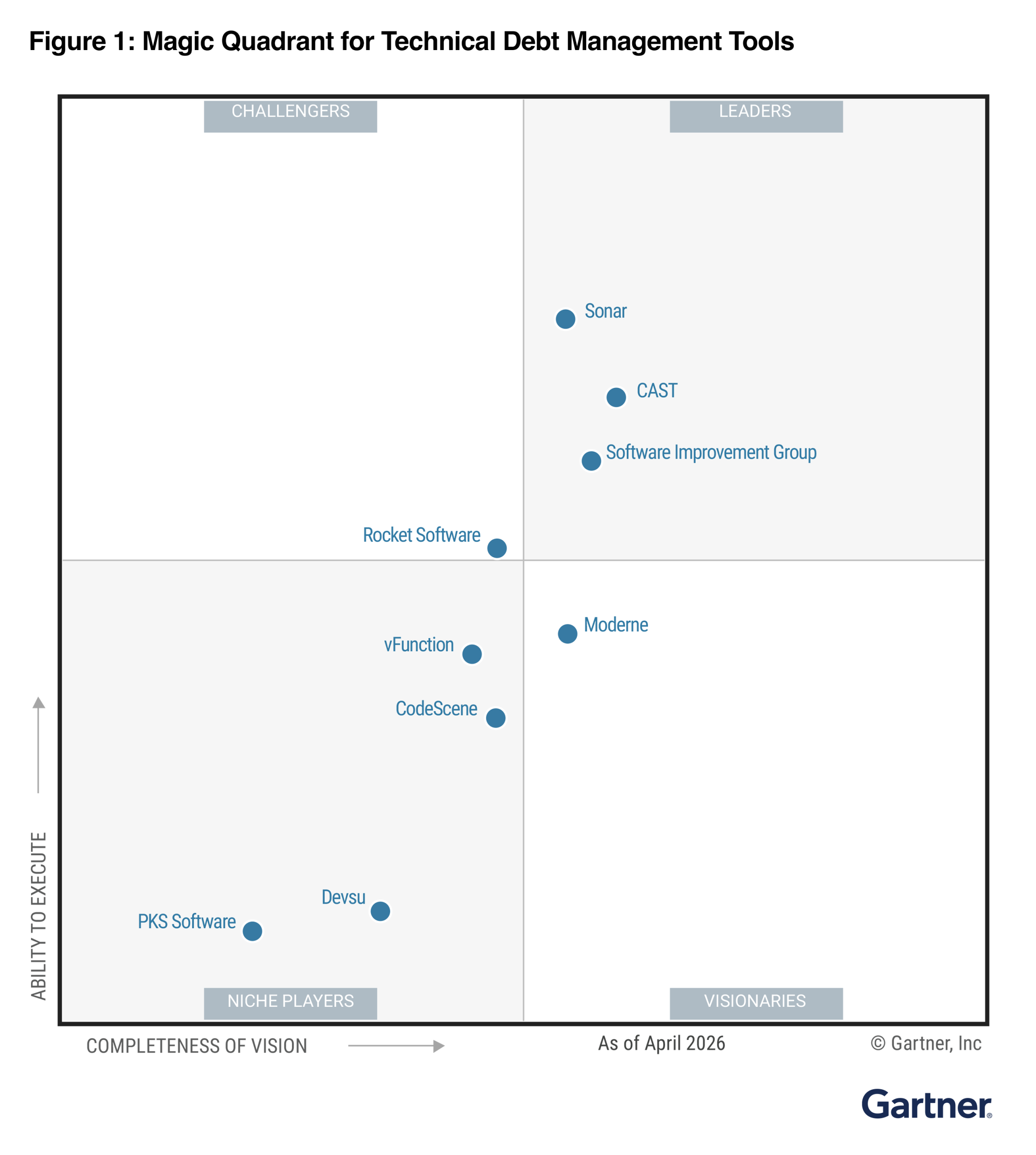
The Gartner® Magic Quadrant™ for Technical Debt Management Tools evaluates vendors on Completeness of Vision and Ability to Execute. Leaders provide mature offerings that meet market demand and have demonstrated the vision necessary to sustain their market position as requirements evolve.
AI coding assistants operate within bounded context windows. They generate code without understanding how it fits into your broader system. The debt accumulates faster than any team can see — let alone govern.
AI coding assistants are increasingly effective when it comes to code-level debt. But the market is shifting toward a harder problem: architectural debt. This debt lives in the relationships between systems. You need portfolio-wide visibility to see it.
AI coding tools operate without domain knowledge of your broader system. They fill architectural gaps independently, without understanding downstream consequences. The result: debt accumulating at machine speed, invisible to machine-level tools.
SIG has analyzed 400 billion lines of code across 30,000+ systems. That evidence base is what Sigrid® is built on — not just alerts, but context, industry benchmarks, and a clear path to remediation.
To us, the Gartner® Magic Quadrant™ gives you the complete picture: market definition, vendor strengths and cautions, evaluation criteria, and how to apply the findings to your technical debt strategy.
How Gartner defines technical debt management tools and what drove the creation of this new category — including the shift from code-level to architectural debt.
Gartner forward-looking view on where architectural debt is heading, and how AI code generation is reshaping the risk landscape.
The specific capabilities Gartner assessed across all vendors — from measurement methodology to architecture observability and developer toolchain integration.
Independent analysis of every vendor in the quadrant — what each does well, where the gaps are, and what that means for your evaluation.
Where AI, agentic development, and enterprise governance are taking this market — and why portfolio-wide architectural governance is the next frontier.
Gartner own guidance on applying these findings to vendor shortlisting, evaluation, and selection for your organization.
Get the full Gartner® Magic Quadrant™ for Technical Debt Management Tools. Understand the market, evaluate vendors, and see how portfolio-wide architectural governance maps to your organization’s needs.
Download your complimentary copyGARTNER is a registered trademark and service mark of Gartner, Inc. and/or its affiliates in the U.S. and internationally, and MAGIC QUADRANT is a registered trademark of Gartner, Inc. and/or its affiliates and are used herein with permission. All rights reserved.
This graphic was published by Gartner, Inc. as part of a larger research document and should be evaluated in the context of the entire document. The Gartner document is available upon request from Software Improvement Group.
Gartner does not endorse any company, vendor, product or service depicted in its publications, and does not advise technology users to select only those vendors with the highest ratings or other designation. Gartner publications consist of the opinions of Gartner’s business and technology insights organization and should not be construed as statements of fact. Gartner disclaims all warranties, expressed or implied, with respect to this publication, including any warranties of merchantability or fitness for a particular purpose.
Gartner, Magic Quadrant for Technical Debt Management Tools, Tigran Egiazarov, Howard Dodd, Aaron Harrison, 20 May 2026.