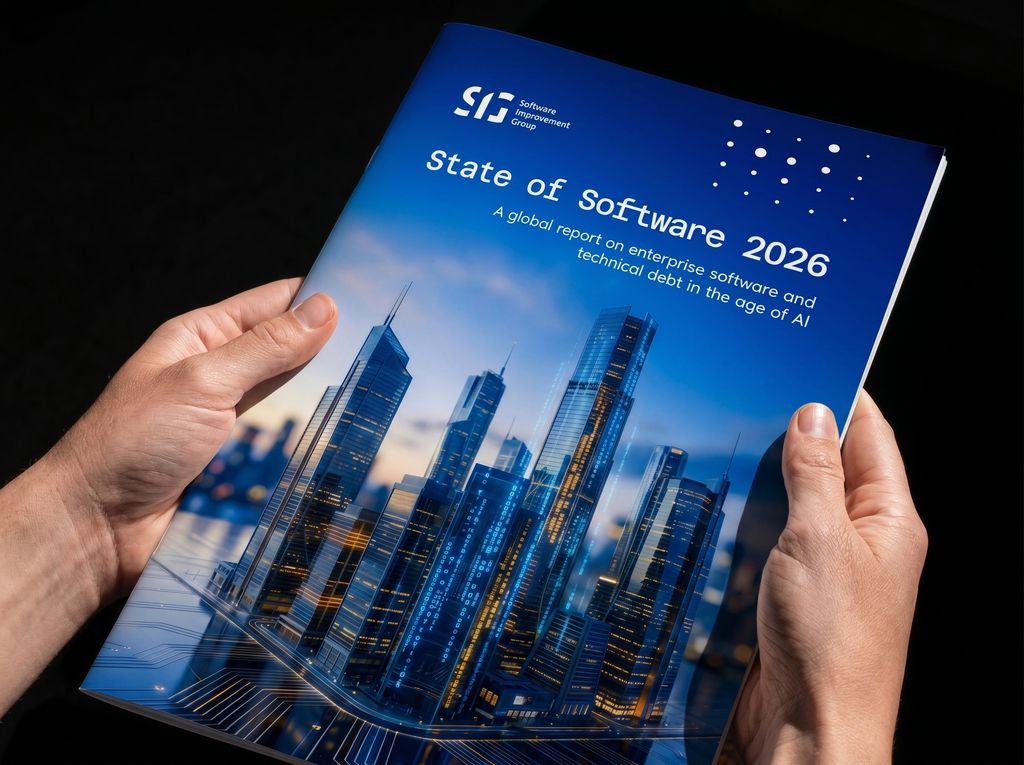
Three years ago, a developer using AI to write code felt novel. In 2026 it is the default.
90% of technology professionals now use AI at work.
The capacity to review that code has not kept pace.
That gap leads to rising technical debt which is the main subject of this report.
Chapter 1. AI coding
AI-generated code carries double the security risk
1.9% of enterprise production code is now AI-generated. AI-generated code carries roughly double the security risk violations of human-written code, and scores lower on maintainability. The gap widens as codebases grow.
Chapter 2. Technical debt
Technical debt costs more than most organizations realize
Technical debt accounts for between 21% and 40% of total IT spending. Reducing code-level technical debt can save €870,000 in developer time, per system, per year. Besides, strong architecture can reduce issue-resolution time by 30%.
Chapter 3. Maintainability
86% of code falls below the recommended maintainability rating
Maintainability is the most overlooked lever in the IT budget. Systems below the threshold lock in engineering capacity organizations need elsewhere. Industries with the most room to improve: startups and scale-ups, pharmaceutical, and telecommunications.
Chapter 4. Security
71% of code has a low degree of security controls
The average-sized system contains 20 critical security findings. Security risk scales with system size: large systems — the most business-critical and the most targeted — average just 2.8 stars.
Chapter 5. Architecture
Strong architecture reduces issue-resolution time by 30%
Architectural debt is a major concern in technical debt management because it sits between system components, not inside individual files. 50% of code is below our recommended architecture quality score.
Chapter 6. AI systems engineering
AI compounds whatever discipline an organization already has
Roughly 1.5% of enterprise systems in production qualify as an AI system. Of those, 72% score below SIG’s recommended maintainability rating. Most organizations are still struggling to move AI from the lab into scalable, secure, compliant production.