Software Improvement Group publishes State of Software 2026
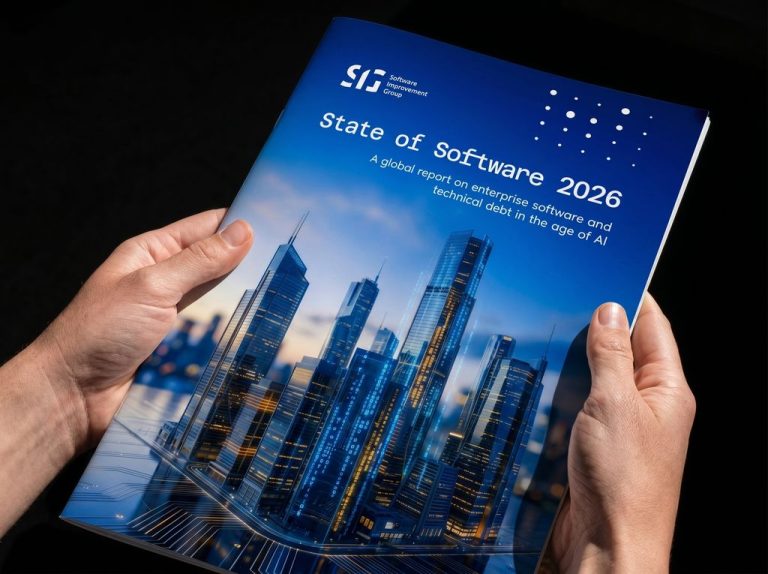
Amsterdam, 9 June 2026 — Software Improvement Group (SIG) has published the State of Software 2026. The report shows the hidden costs and risks of enterprise software, this year measured against the full force of AI adoption.
The report examines what changes when AI-assisted coding goes mainstream and agents begin to write, test, and merge code with less human involvement.
The central finding is that AI does not fix or break software discipline on its own. It amplifies what is already there. Where code and architectural quality are measured and managed, AI accelerates delivery. Where it isn’t, it accelerates technical debt, cost, and security exposure.
“None of what’s in this report is an argument against AI. The productivity gains are real, and the organizations that step back from it will fall behind the ones that learn to use it well. But you cannot manage what you cannot measure, and you cannot move fast for long on a foundation you do not understand. When generation outruns governance, technical debt accumulates faster, security exposure widens, and the systems a business depends on become harder to change,” said Luc Brandts, CEO at Software Improvement Group.
Key findings
- AI adoption in enterprise: AI-generated code now accounts for 1.9% of enterprise production code.
- AI code security: In SIG’s testing, AI-generated code carries roughly double the security risk violations of human-written code.
- Non-agentic AI-assisted engineering cost: AI token spend for a team of 50 developers now averages the equivalent of nearly one additional developer.
- Agentic coding tasks can consume up to 1,000 times more tokens than standard code chat or reasoning.
- Technical debt: Reducing code-level technical debt can save €870,000 in developer time, per system, per year.
- Maintainability: 86% of code falls below SIG’s recommended maintainability rating.
- Architecture: 50% of code scores below SIG’s recommended architecture rating, and a stronger architecture cuts issue-resolution time by 30%.
- Security: 71% of code has a low degree of security controls, and systems with lower code-level technical debt show up to 72% stronger security compliance.
- AI systems engineering: 72% of AI systems in production score below SIG’s recommended build-quality rating.
The report draws on Software Improvement Group’s benchmark data, set against independent research. SIG’s benchmark spans more than 30,000 systems and over 400 billion lines of code; this year’s findings draw on the systems analyzed over the past year.
Download the State of Software 2026 here.
About Software Improvement Group
Software Improvement Group (SIG) empowers organizations to govern the software their business runs on. Through complete portfolio analysis and tailored strategic advice, SIG helps companies embrace AI with control, improve software quality and security by focusing strategic efforts across people, process, and technology.
Sigrid®—its software portfolio governance platform—analyzes over 400 billion lines of code across more than 30,000 systems and 300+ technologies, offering evidence-based insights to help organizations prioritize and manage their most critical IT initiatives.
Founded in 2000 and headquartered in Amsterdam, SIG has offices in New York, Copenhagen, Brussels, and Frankfurt. The company complies with leading ISO/IEC standards, including 27001 and 17025, and co-developed ISO/IEC 5338—the new global standard for AI lifecycle management.
Combining expert consulting with over 25 years of industry-leading research, SIG is the global authority on continuous software portfolio governance.
For more information, please visit Software Improvement Group‘s website or social media channels.